On this sheet / 6 parts
Alcock and Brown are usually filed under aviation history, but both men were Manchester products. One learned his trade in a city motor works, the other in an electrical engineering apprenticeship at Trafford Park, and both went to the same Manchester school. Their 1919 flight is a story about two engineers as much as two heroes.
Captain Jack Alcock of Firswood
John William Alcock, known as Jack, was born on 5 November 1892 on Seymour Grove in Firswood, close to Old Trafford. One tradition puts his birth in the coach-house beside Basford House on that road, though nobody has firmly documented it. He went to Heyhouses School in Lytham St Annes from 1900 to 1905, when his family was living on the Fylde coast.
His first job was at the Empress Motor Works in Manchester. In 1910 he became assistant to the works manager Charles Fletcher and the motor engineer Norman Crossland. From there he moved south to Brooklands aerodrome in Surrey as a mechanic for the French aviator Maurice Ducrocq, learned to fly at Ducrocq's school and gained his pilot's licence in November 1912.
The war made him an instructor and then a fighting pilot. He joined the Royal Naval Air Service as a warrant officer instructor at Eastchurch, was commissioned in December 1915 and sent to Moudros on the island of Lemnos in 1916. He won the Distinguished Service Cross for an action in September 1917, then ditched near Suvla Bay and spent the rest of the war as a prisoner of the Turks. He left the RAF in March 1919 with the rank that gave him his popular name: Captain Jack Alcock.
Arthur Whitten Brown, the navigator
Brown was born in Glasgow on 23 July 1886 to American parents. His father, an electrical engineer, had come to Britain to assess a site for a Westinghouse factory, and when it was built at Trafford Park the family settled in Manchester, first in Chorlton and then near the works. Brown, like Alcock, went to Manchester Central High School for Boys, and he served an apprenticeship with British Westinghouse, the firm that later became Metropolitan-Vickers.
In the war he was an observer with 2 Squadron of the Royal Flying Corps. He was shot down twice, the second time in November 1915, captured, interned in Switzerland and sent home in September 1917. Navigation, not flying, was his specialism, and on a 1919 Atlantic crossing that mattered far more than it sounds.
The Vimy and the prize
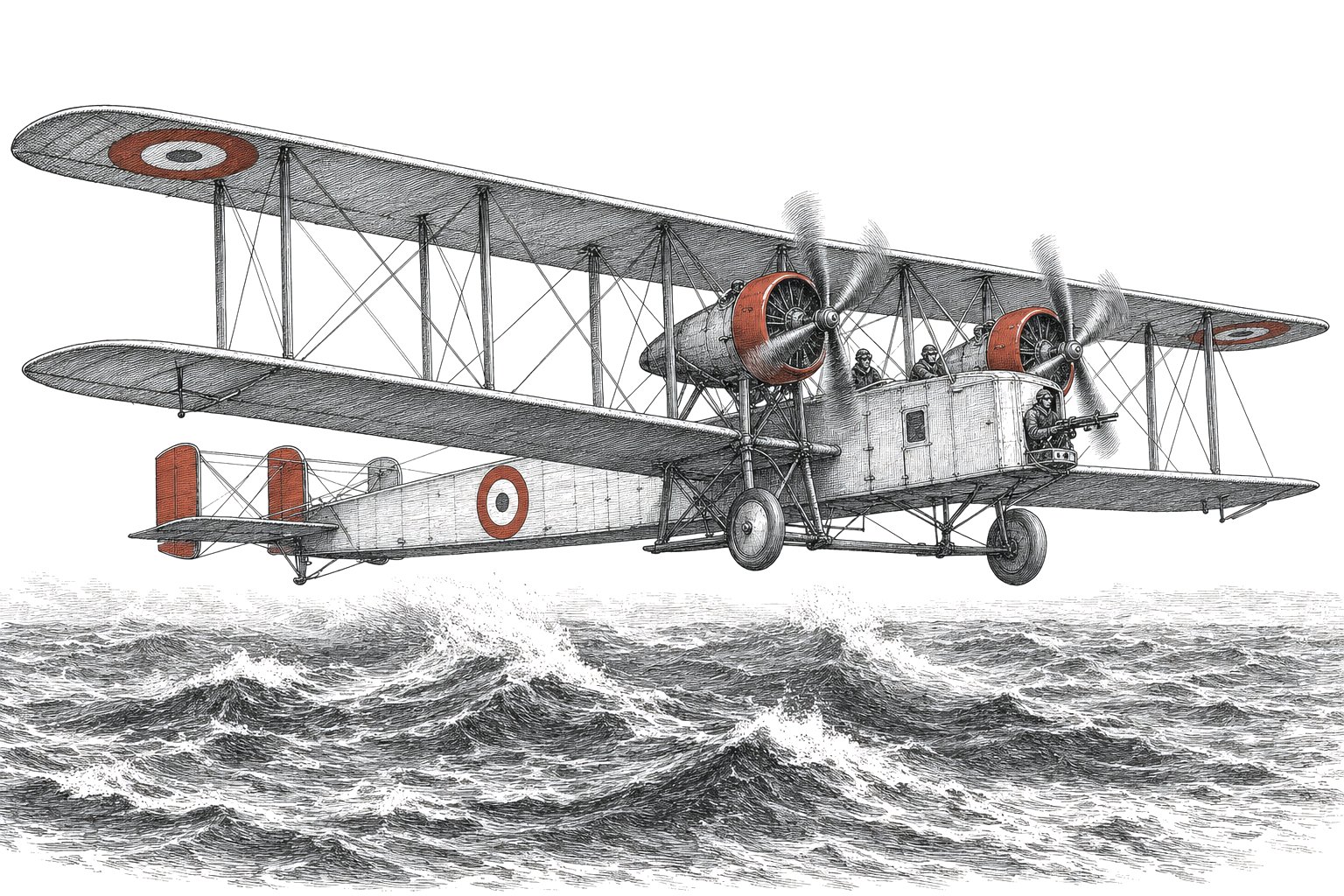
The Daily Mail had offered £10,000 for the first non-stop crossing of the Atlantic by air in under 72 consecutive hours. Vickers entered a converted Vimy bomber, a twin-engined biplane with two Rolls-Royce Eagle engines of 360 horsepower each. The bomb load gave way to fuel tanks, and the aircraft left with 865 imperial gallons on board.
They were not alone in Newfoundland. A Handley Page team under Admiral Mark Kerr was in the final stages of testing its own aircraft, and Kerr was determined not to leave until it was in perfect condition. The Vickers men did not wait.
The flight of 14-15 June 1919
Alcock and Brown took off from Lester's Field, St John's, at about 1.45 pm on 14 June 1919. At about 5 pm they flew into thick fog, which stopped Brown using his sextant. They had no gyroscopic instruments, so flying blind in cloud was a real danger, and twice Alcock lost control in a spiral dive and nearly hit the sea. Ice threatened the airframe and the carburettors. A popular story has Brown climbing out onto the wings to clear the engines, though he never mentioned doing so himself. When the cloud finally broke he got a glimpse of the stars, took a sextant sight and found they were on course.
They crossed the Irish coast the next morning and picked what looked from the air like a suitable green field near Clifden in County Galway. It was Derrygimlagh bog. The Vimy touched down at 8.40 am on 15 June and tipped onto its nose. Neither man was hurt.
| Flight data | Value |
|---|---|
| Crew | John Alcock (pilot), Arthur Whitten Brown (navigator) |
| Aircraft | Vickers Vimy, modified bomber |
| Engines | 2 x Rolls-Royce Eagle, 360 hp each |
| Fuel at take-off | 865 imperial gallons (3,900 litres) |
| Departure | Lester's Field, St John's, Newfoundland, about 1.45 pm, 14 June 1919 |
| Arrival | Derrygimlagh bog near Clifden, Co. Galway, 8.40 am, 15 June 1919 |
| Time in the air | 15 hours 57 minutes |
| Distance | about 1,890 miles (3,040 km) |
| Average speed | about 115 mph (185 km/h) |
| Prize | £10,000, Daily Mail, presented by Winston Churchill |
The prize was handed over by Winston Churchill, and a week after landing both men were knighted by King George V at Windsor Castle.
After the flight
The fame was short for one of them. On 18 December 1919 Captain Jack Alcock was flying a new Vickers Viking amphibian to an air show in Paris when he crashed in fog at Cottévrard, near Rouen. He died of his injuries, aged 27. He was buried in Southern Cemetery, Manchester, on Barlow Moor Road, where a large stone memorial marks the grave.
Brown lived another three decades. In 1923 he became chief representative for Metropolitan-Vickers in the Swansea area, served in the Home Guard in the Second World War and then rejoined the RAF to teach navigation until ill health forced him out in 1943. He died in Swansea on 4 October 1948, aged 62, after an accidental overdose of the sleeping drug Veronal. He is buried at Tylers Green in Buckinghamshire.
Where Alcock and Brown are remembered
In Manchester the two places to go are Alcock's grave in Southern Cemetery and Manchester Airport, which has a memorial to the pair by the sculptor Elisabeth Frink, commissioned by Manchester City Council in the early 1960s. The airport is less than eight miles from the street where Alcock was born.
A common mix-up concerns the larger bronze of the two men by William McMillan. It was unveiled at Heathrow in 1954, travelled to Clifden for the centenary in 2019 and was moved to Brooklands, where Alcock had learned to fly, in February 2020. It has never been in Manchester. Another sculpture of the pair stands near the former Vickers works at Crayford in south-east London, where the first Vimys were made; the Atlantic aircraft itself was assembled at Weybridge.
For the factory where Brown trained, see the page on Metropolitan-Vickers. For the aircraft industry that grew in the city after them, read about Avro, and for the wider story of Trafford Park and the working districts, the industrial Manchester hub.