On this sheet / 8 parts
Beyer Peacock is a name most people meet on a works plate, fixed to the side of a locomotive in Tasmania, South Africa or north Wales, with Manchester given as the place of building. Behind the plate was the Gorton Foundry, a 12-acre works in Openshaw, east Manchester, that sent its first engine out in July 1855 and its last in 1966.
Three founders and a 12-acre site
Charles Beyer came to Manchester from Plauen in Saxony and joined Sharp, Roberts and Company in 1834 as a draughtsman. He rose to chief engineer and left in 1853. Richard Peacock, born in 1820, had been locomotive superintendent of the Manchester, Sheffield and Lincolnshire Railway since 1847 and had set up that railway's works at Gorton.
The two men started building the Beyer Peacock Gorton Foundry in 1854 on a 12-acre site at Openshaw. The money came partly from Henry Robertson, a Scottish civil engineer and railway builder in north Wales, who joined as a sleeping partner and financial adviser from 1 January 1855.
A small point causes a lot of confusion: the Gorton Locomotive Works of the railway company, often called Gorton Tank, was a different place with a different owner, and the two are easy to confuse. The seven EM2 electric locomotives of 1953 and 1954, for example, were built at the railway works, with electrical equipment from Metropolitan-Vickers, not by Beyer Peacock.
A short history of the Gorton Foundry
The first locomotive left Gorton in July 1855, for the Great Western Railway. Export orders arrived almost at once. Between 1854 and 1868 the firm built 844 locomotives, and 476 of them were for railways overseas, mainly in British colonies, southern Africa and South America.
Both founders became wealthy men. Peacock lived at Gorton Hall, paid for Brookfield Unitarian Church in Gorton and sat as Liberal MP for the Gorton division from 1885 until his death in 1889. Beyer left about 114,000 pounds to Owens College; the money paid for the Beyer Building of 1888 and for professorships in engineering and mathematics, which makes him the largest single benefactor in the history of the University of Manchester.
Beyer Peacock locomotives for the world
London's first underground railway needed an engine that would not fill its tunnels with steam. Beyer Peacock's answer, the Metropolitan Railway A class 4-4-0 tank, condensed its exhaust back into the water tanks, and 148 were built between 1864 and 1886. It was the first successful condensing locomotive.
Most of the output went much further. Gorton's customers were mainly in the British colonies, southern Africa and South America, and the later Garratts spread across Africa, South America, Asia, Australia and the South Pacific. A railway that wanted more power than its light track could carry in one rigid engine was the ideal buyer.
How a Garratt locomotive works
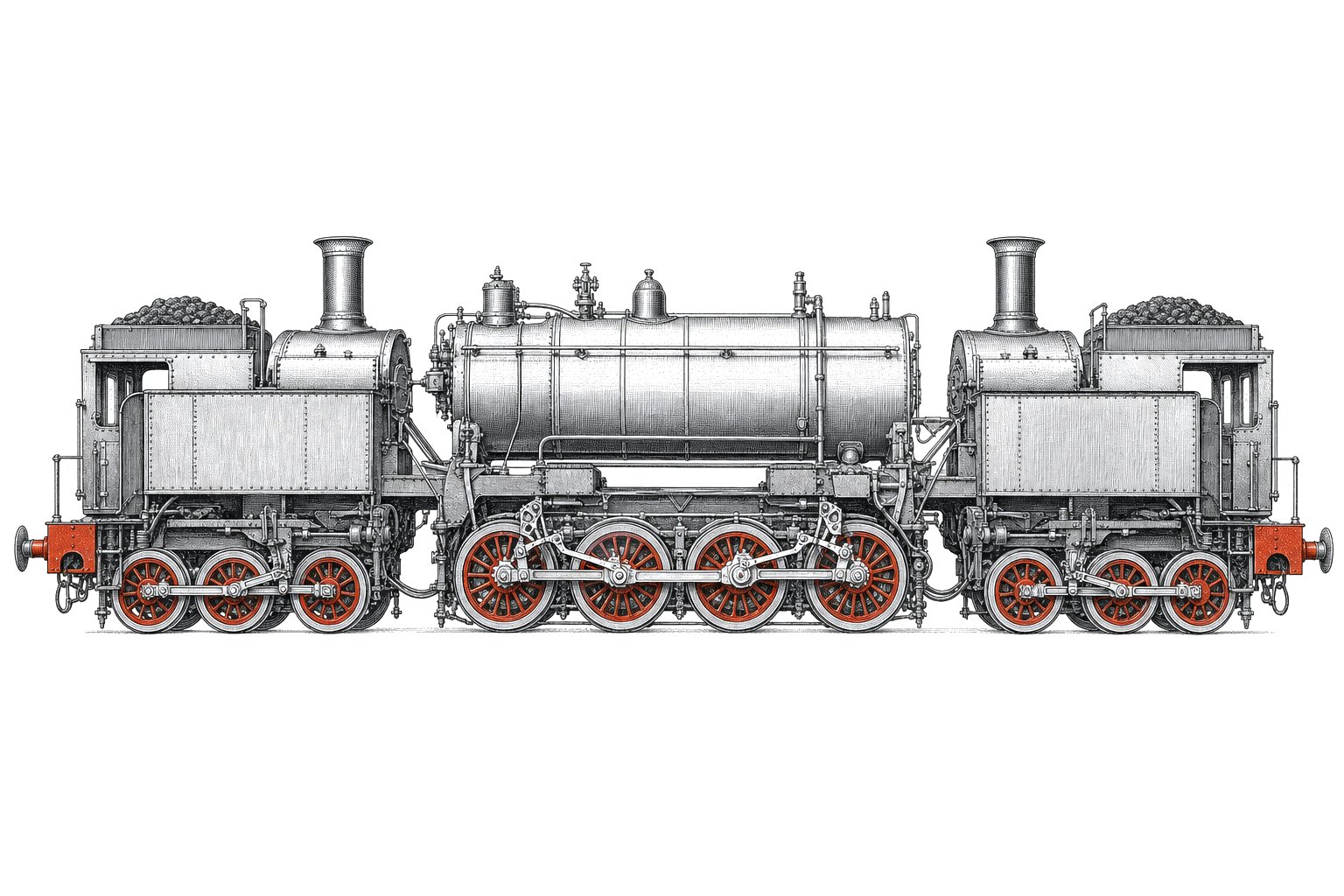
Herbert William Garratt was a British engineer who patented an articulated design in 1908, and Beyer Peacock took the sole rights to build it in Britain. A Garratt locomotive is in three parts. The boiler, firebox and cab ride on a central frame. That frame is slung between two separate engine units, front and rear, each with its own wheels and cylinders, and each carrying water or fuel.
Because nothing sits under the boiler, the firebox and ashpan can be as wide and deep as the designer likes. The two engine units pivot, so a long and powerful engine can follow curves on a light, twisting track. It runs equally well in either direction. On some railways the first Garratts produced as much as twice the tractive effort of the largest conventional engines in service.
The first Garratt locomotive was K1, one of two built in 1909 for the Tasmanian Government Railways. More than a thousand Garratts followed from Gorton up to 1958. The most powerful was the South African Railways GL class of 1929, and the last was the South African NG G16 class of 1958.
Notable Beyer Peacock classes
| Class | Railway | Year | Notes |
|---|---|---|---|
| A class 4-4-0T | Metropolitan Railway | 1864-1886 | 148 built, condensing engine for underground lines |
| K class Garratt | Tasmanian Government Railways | 1909 | First Garratts, 2 built (K1, K2) |
| U1 2-8-0+0-8-2 | London and North Eastern Railway | 1925 | One built, 2-8-0+0-8-2 |
| LMS 2-6-0+0-6-2 Garratt | London, Midland and Scottish Railway | 1927 and 1930 | 3 then 30 built |
| GL class Garratt | South African Railways | 1929 | Most powerful Garratt built at Gorton |
| NG G16 Garratt | South African Railways | 1958 | Last Garratt from the works |
| Class 35 Hymek | British Railways | 1961 | Diesel-hydraulic |
Export railways and narrow-gauge tanks
The Benguela Railway in Angola shows how far the Gorton order book reached. A 99-year concession for the line was granted to Sir Robert Williams in November 1902, construction began in March 1903, and the 3 ft 6 in gauge railway from Lobito on the Atlantic coast reached Luau, on the border of the Belgian Congo, in 1929. Tanganyika Concessions, a London holding company, owned about 90 per cent of it.
Heavy trains on the Benguela were worked by Garratts. It was the largest user of the 4-8-2+2-8-4 type in Angola, with 48 locomotives, all built by Beyer Peacock between 1927 and 1956, in four classes: 10A of 1927, 10B of 1930, 10C of 1951 and 1952, and 10D of 1955 and 1956. Steam lasted a long time there. The line was oil-fired from the coast to Cubal and burned wood further inland, eucalyptus from plantations grown near the railway for the purpose, and steam locomotives still outnumbered diesels in 1987.
The other end of the scale was the Isle of Man Railway. All but one of its locomotives came from Beyer Peacock between 1873 and 1926, and they are 2-4-0 tank engines on 3 ft gauge track: two leading wheels, four coupled driving wheels and no trailing wheels. No. 1 Sutherland arrived on the island on 27 March 1873, and No. 16 Mannin of 1926 was the last steam locomotive supplied to the line. The one exception, No. 15 Caledonia, was built by Dübs and Company of Glasgow. Beyer Peacock 2-4-0Ts still work the 15.5 miles (25 km) from Douglas to Port Erin, which opened on 1 August 1874.
Reading a works list, the wheel arrangement is worth checking twice. The Metropolitan Railway A class in the table above is a 4-4-0T, with four leading wheels; the Manx engines have a single leading axle and are 2-4-0Ts.
Diesels, Hymeks and closure
Steam orders were already thinning when, in 1949, Beyer Peacock formed a joint company with Metropolitan-Vickers of Trafford Park to build non-steam locomotives. British Railways Class 82 electrics were built in Manchester with Metrovick electrical equipment. In 1961 came the Class 35 diesel-hydraulic, the Hymek; a separate company, Beyer Peacock (Hymek) Ltd, had been formed in 1958 as a joint venture of Bristol Siddeley Engines and Stone-Platt Industries.
None of it saved the foundry. The company all but closed Gorton at the end of 1958, and production ceased in 1966, 112 years after the works began. Nearly 8,000 locomotives had been built. The company was sold to National Chemical Industries of Saudi Arabia in 1976 and last filed accounts in 1989.
What survives today
Almost nothing of the Beyer Peacock Gorton Foundry still makes anything. The former boiler, tender and boiler-mounting shop, a building 167 metres long, was still standing as part of a Manchester City Council depot in 2012. The stationary relative of those boilers is described on the Lancashire boiler page. For anyone following that history further, the surviving locomotives are the most complete record.
The best surviving monument is a working engine. K1, the first Garratt locomotive, was bought back by its builder in 1947, sold to the Ffestiniog Railway in 1966, and found to be too tall and wide for that line. It was reassembled at Boston Lodge for the rebuilt Welsh Highland Railway, converted to oil firing and returned to steam in 2004, entering regular passenger service in October 2007. Withdrawn for overhaul in 2014, it moved to the Statfold Barn Railway in 2019 and was running again in August 2020, on 2 ft gauge track, a long way from Gorton.
For the wider picture of the city's engine builders, see the Machines section, and for the canal that first brought cheap coal into Manchester, the Bridgewater Canal.