On this sheet / 5 parts
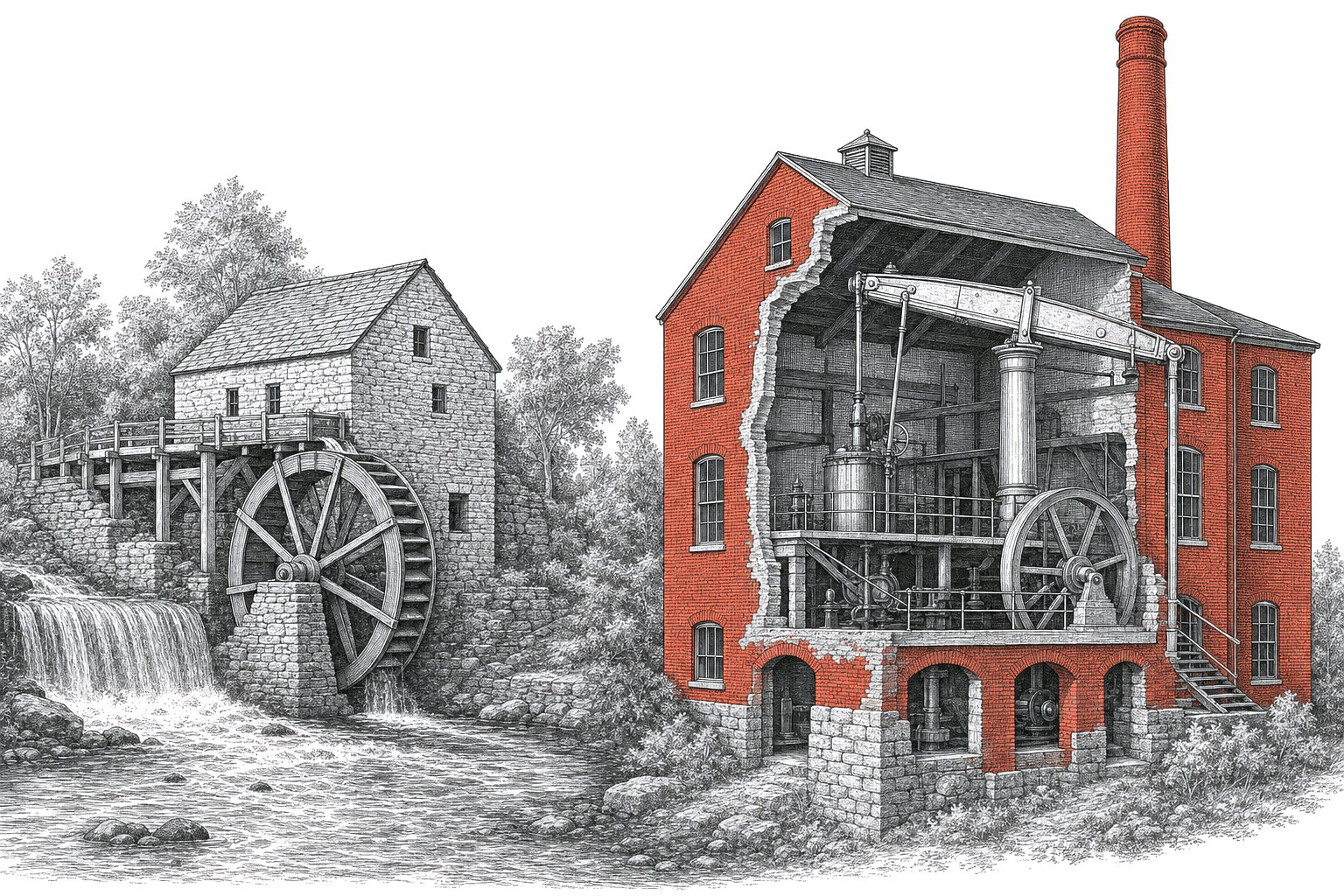
For a few years in the 1780s the most modern cotton mill in Manchester used a steam engine to keep a waterwheel turning. That arrangement, at Richard Arkwright's mill on Shudehill, is the clearest way into the move from water power to steam power, because it shows the engineers of the day did not yet trust the engine to do the job on its own.
Rivers that were not quite enough
The early factory system ran on falling water. Arkwright's water frame was named for its power source, and the first generation of spinning mills went where the gradient was: Cromford in Derbyshire, the Pennine valleys, the Bollin at Styal. Manchester sat on the Irwell, the Irk and the Medlock, with the Tame further east, and none of them falls steeply through the town. A large spinning mill needed more head than the town's rivers could give.
Arkwright's partners built anyway. Shudehill Mill, also called Simpson's Mill, went up in 1782 between Miller Street and Angel Street: five storeys, about 200 ft long, an Arkwright-type building of the sort he had already put up in Derbyshire. A waterwheel about 30 ft across drove the machinery. Because there was not enough natural flow, the water ran between an upper and a lower storage pond, and a Newcomen-type atmospheric engine by Hunt, with a 64 in cylinder, pumped it back up again.
Whether the engine ever tried to drive the mill directly is still argued about. Wessex Archaeology excavated the site in 2004 and found that the wheel pit lay inside the building and the mill was always about 12 m wide, and the dig was filmed for a Time Team episode in 2006. The mill burned in 1854, was rebuilt and raised to seven storeys, and was destroyed in the Manchester Blitz on 23 October 1940. The site is a car park now.
Boulton and Watt arrive in Manchester
James Watt patented his rotative engine in 1781, a machine built to turn the wheels of mills directly rather than pump water for them. Its arrival in Manchester was quick. Peter Drinkwater's four-storey mill on Auburn Street, near Piccadilly, was begun in 1789, and its 8 hp Boulton and Watt engine was working by 1 May 1790. It was the first cotton mill in Manchester driven directly by steam, although only the preparatory machines ran off the engine at first; the spinning was still done by hand.
Shudehill followed. A 6 hp Boulton and Watt engine was fitted there in 1790, a 40 hp one was running by 1792 and a 30 hp engine came in 1799, each added to drive more spindles. The pump-and-wheel arrangement had become a sideline.
The numbers moved quickly from there, and the change from water power to steam power in the town was close to complete within a generation. Manchester had 42 mills by 1800, and Manchester and Salford together more than 50 by 1802. Almost none of them could have existed on water power.
Why steam won in Manchester
The short answer is coal and canals. A steam mill could be built wherever fuel could be delivered cheaply, and Manchester was unusually well placed. The Bridgewater Canal, completed in 1764, brought coal from the Duke's mines at Worsley, and the Manchester coalfields lay under Salford and east Manchester. Pendleton Colliery alone supplied about a quarter of the town's coal in 1836.
Ancoats is where you can see the result. Adam and George Murray began Old Mill at what became Murrays' Mills in 1797, between Jersey Street and the line of the Rochdale Canal. It had a 12 hp Boulton and Watt engine, later replaced by a 40 hp one, and the New Mill alongside took 45 hp engines. When the Ancoats section of the canal opened in 1804 a private basin brought coal and raw cotton straight to the mill and took spun yarn away. Old Mill is described as the oldest surviving urban steam-powered cotton spinning factory in the world, and it is listed Grade II*. Stand on Jersey Street and the logic is obvious: canal, engine house, mill, all on one block, with the workers' streets around it. A waterwheel could never have put a mill there.
There was also reliability. A river runs low in summer and freezes in winter, and a mill on a shared stream depends on what the mills upstream do with the water. An engine just needed coal and boiler water.
Quarry Bank: the comparison at Styal
Quarry Bank Mill is the best place to understand the move from water power to steam power, precisely because it held out so long. Samuel Greg built it on the River Bollin at Styal in 1784. Its Great Wheel, designed by Thomas Hewes, was 32 ft in diameter and turned from 1818 to 1904; an 1835 report rated it at 120 horsepower. Even so, Greg's mill needed help. A 10 hp Boulton and Watt beam engine was added in 1810 because the river flow was unreliable.
Today the National Trust, which was given the site in 1939, runs a 25 ft waterwheel moved from Glasshouses Mill near Pateley Bridge and installed in 1983 to drive the machinery. The original steam engines have gone, and the steam engine on display there is a similar one that does not run. When you visit, notice how much of the site exists only to manage the water, from the weir to the tailrace.
From beam engines to mill engines
By about 1820 the stationary steam engine was the usual source of power for cotton mills. Early engines were low-pressure, single-cylinder condensing beam engines, with a rocking iron beam over the cylinder and a flywheel driving gears and vertical shafts. Average mill power was only 48 hp in 1835.
Higher boiler pressures changed the scale. The Lancashire boiler, a Manchester design, made them practical. Horizontal engines began replacing beam engines in the 1870s, triple-expansion horizontals were standard by 1890, and from 1875 ropes running in grooved flywheels drove the line shafts on each floor. Abbey Mill in Oldham needed 700 hp in 1876; Nile Mill needed 2,500 hp in 1896. In 1860 Lancashire's mills were already using 300,000 hp in total, of which water power supplied 18,500.
The water had not gone, though. Every one of those engines still needed water to make steam and to condense it, which is why the cotton mills of Ancoats and Oldham still hugged canals and lodges long after the last wheel stopped. The exchange rate between the heat in that steam and the work on the line shaft was measured in Salford in the 1840s, by James Joule.