On this sheet / 7 parts
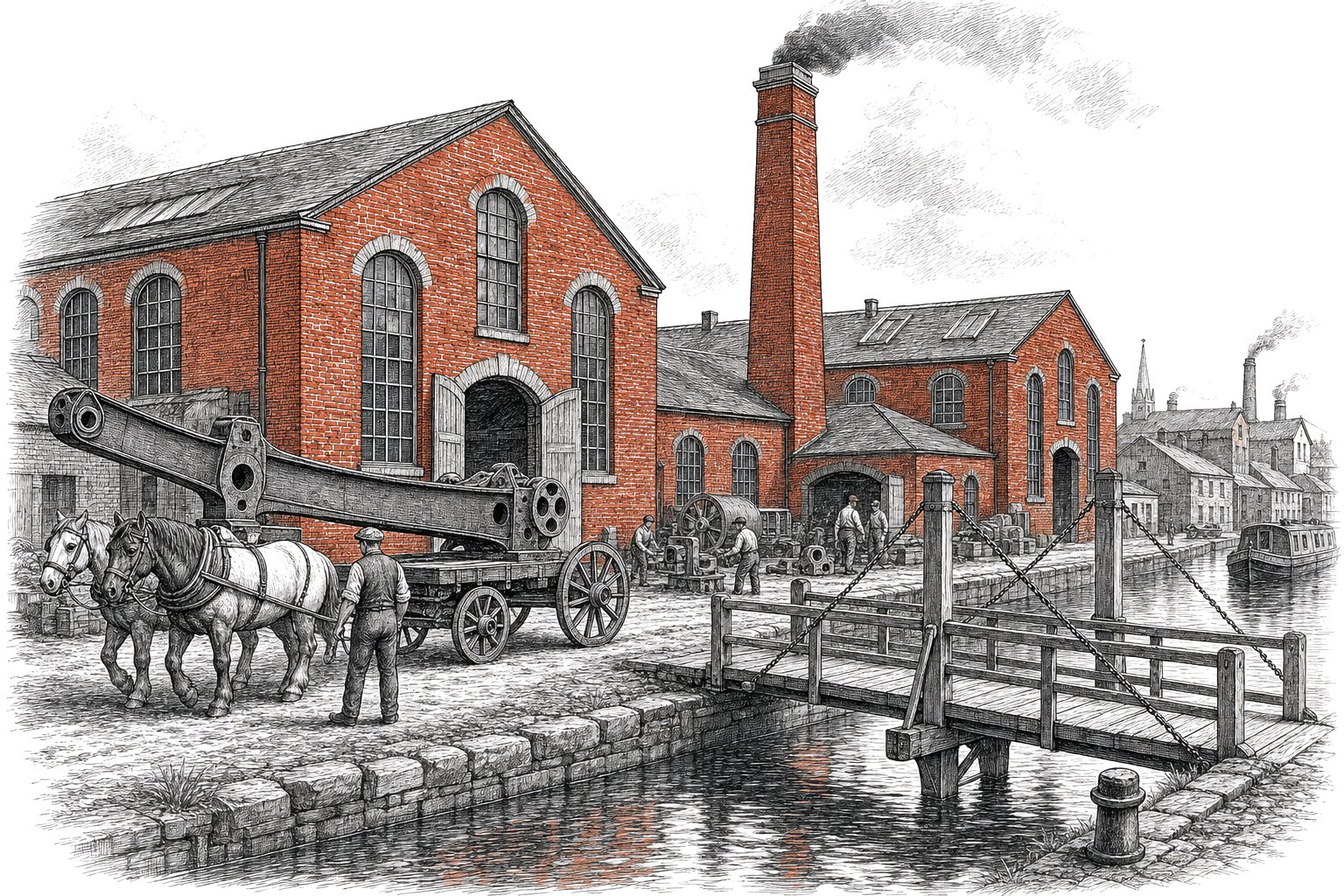
The Soho Foundry stood on Pollard Street in Ancoats, with the road on one side and the Ashton Canal on the other, and for most of the nineteenth century it was one of the busiest engine works in Manchester. Peel, Williams and Company took it over in 1810. When the site was auctioned in 1886, its beam engines, hydraulic presses and heavy forgings had gone to mills, distilleries and collieries from Cumbria to Alsace, and to cotton presses in India.
Peel, Williams and the move to Ancoats
The firm was older than its Ancoats address. By 1800 George Peel Senior, a cousin of Sir Robert Peel, and William Ward Williams (1772-1833) were running an iron and brass foundry in Millar's Street and the Phoenix Foundry in Swan Street, Shudehill. They made standard gear wheels, hydraulic presses, looms and portable steam engines, and a catalogue of 1806 offered castings for water wheels, gears, weighing machines, factory heating, spinning rollers and wrought-iron shafting.
In 1810 the partners acquired the Soho Foundry beside the Ashton Canal. It had been founded by David Whitehead, who had built Richard Trevithick's high-pressure engines there. After George Peel Senior died the business became Peel and Williams, and around 1825 his sons Joseph and George Peel joined Williams, giving the name Peel, Williams and Peel, which it kept to the end. Judged by its poor rate valuation, it was possibly the largest engineering concern in Manchester by 1820.
One warning for anyone searching old catalogues: Boulton and Watt also had a Soho Foundry, at Smethwick near Birmingham. The two are unrelated. To add to the muddle, a small Watt-type engine marked Soho, paraded through Manchester for the coronation of George IV on 19 July 1821, was a Peel and Williams engine.
Two foundries on the Ashton Canal
Bancks's map of 1831 shows two works, the Soho Foundry and the Soho New Foundry, separated by a branch of the canal. The Ordnance Survey map of 1849 shows the halves joined by two wooden footbridges, one of them a swing bridge, with a weighing machine at the southern entrance. Ancoats grew up around its canals, as the working city section describes, and the foundry was built with water on two sides.
In 1827 a scrap-iron forge opened on the site, making bars, shafts and coach axles from scrap with a hammer of over five tons. A year later a serious fire destroyed the old foundry on Pollard Street, but the large new foundry, a separate building, was untouched. The same year the works cast a cylinder with a bore of 6 ft 8 in and a length of 9 ft 6 in, weighing about 6 tons 10 cwt, for a Scottish blast furnace; boring it out took 34 days.
The canal also served as a test track. In 1819 the firm built the steam engine for an experiment on the Ashton Canal near the foundry, trying out Mr Rastrick's method of steam propulsion.
Beam engines for mills and distilleries
Stationary engines were the core of the trade, and they travelled. In 1812 the firm supplied the engine for Dollfus Mieg and Company at Mulhouse, the first steam-powered cotton mill in Alsace. A 40 horsepower engine drove a new mill at the bottom of Union Street, Higher Ardwick, in 1825, and in 1832 an engine went to Langthwaite Cotton Mill in Cumbria to cut its reliance on water power. For how such engines turned shafts and spindles inside a mill, see Manchester's cotton mills.
Several engines outlived the works. A six-column beam engine supplied in 1834 or 1835 to Midleton Distillery near Cork stayed on standby until 1972 and was still on site in 2023. A beam engine of around 1838, formerly at Best and Lloyd of Smethwick, is preserved at Blists Hill Victorian Town in Shropshire. A pumping engine sold in 1866, with a 78 in bore and a 10 ft stroke, has been identified as the Wharf Pit pumping engine. Directories of 1841 also list the firm as boiler and gasometer makers; the boilers that fed engines like these are covered on the Lancashire boiler sheet.
The Soho locomotive of 1839
Railways were a brief chapter. In 1838 a new engine from the works, on trial on the Leeds line near Rochdale, ran into an empty truck left on the track; the crew jumped clear without serious injury. The following year the firm sent its first locomotive, named Soho, to the Liverpool and Manchester Railway, whose Manchester terminus is described on the Liverpool Road station page. After a fortnight on passenger trains it hauled 25 loaded wagons weighing 133 tons from Liverpool to Manchester.
The Soho had 5 ft 6 in driving wheels, 11 in cylinders and 85 boiler tubes, and it drove its valves through spur wheels in place of the usual eccentrics. Edward Woods, the railway's superintendent engineer, supplied the trial results. Most of the firm's products traced in later directories and sale notices are stationary engines, presses and forgings. Manchester's big locomotive builder came later, at Beyer Peacock in Gorton.
Hydraulic presses and heavy forgings
By 1853 directories described the firm as makers of hydraulic presses too, and cotton presses became a speciality. A newspaper report of 1863 described its lighter presses, each making a 336 lb bale, with one press handling 40 bales in a ten-hour day. In 1865 George Peel Junior and Isaac Mason of Sale applied for a patent on hydraulic cotton presses, and in 1866 a large press to Mason's design, driven by a two-cylinder horizontal engine, went to the Mofussil Cotton Pressing Company in India.
The forge also turned out very large single pieces. In 1847 the firm sent a wrought-iron shaft 31 ft long, weighing about 10 tons, and a pulley more than 16 ft across to the tunnel at Wapping, Liverpool, on the London and North Western Railway. At the London Exhibition of 1862 it won a medal for its machinery, and the same year it forged a water-wheel shaft from scrap, 30 ft long, 22 in in diameter and weighing 13 tons, shaped under a steam hammer of seven or eight tons over about nine days.
The men on the foundry floor
Newspaper notices give a picture of the workforce. In 1826, when hard times led to lay-offs, more than 200 workmen met, and George Peel Junior proposed that each man still working give sixpence a week to a relief fund, with the firm adding a weekly sum of its own. Service was long. Amos Pearson, the firm's engineer and foreman for 36 years, died in 1860 aged 79; James Mellor, who died in 1861 after 40 years with the firm, had served in the Royal Navy at Trafalgar in 1805.
The work was dangerous. In 1858 a blast tenter named Robinson died after the bow of a ladle broke while a casting of nearly five tons was being moved, and in 1867 Thomas Buckley, aged 13, was killed while helping to forge a large shaft. Both inquests returned verdicts of accidental death.
Sale, demolition and what is left
On 14 December 1886 the auctioneers William Wilson and Son offered the Soho Ironworks: two freehold plots of about 6,906 and 5,174 square yards, with frontage on Pollard Street and the canal. The contents went under the hammer over three days from 18 May 1887, including boilers, beam engines, cranes, lathes, planing machines, hydraulic presses, forge hammers and the pattern stock.
The buildings found new tenants. The Union Alkali Company occupied the Soho Works from 1895 and still held part of them in 1967. Goad's insurance plans of 1928 show Edwin Butterworth in the north-east half and the Union Alkali Company with Hamilton and Sons, printers' engineers, in the south-west. A photograph of 1967 shows the Pollard Street frontage with its 80 ft chimney. Everything was later demolished, and in 2010 the last trace on the ground was part of the old western wall, still standing as a boundary wall.