On this sheet / 8 parts
The Manchester cotton mills that survive are mostly in Ancoats, a short walk north-east of Piccadilly, and they are older than most people expect. The Old Mill at Murrays' Mills was begun in 1797. By the time the word Cottonopolis came into use, around 1870, Manchester had already passed its peak as a spinning town and was becoming the place where cotton was bought, sold and stored rather than spun.
Cottonopolis: the name and the numbers
The steam-powered textile mill started here. Richard Arkwright's Shudehill Mill on Miller Street (1782) already had an engine, though only to pump water back to its wheel, and Peter Drinkwater's mill on Auburn Street was driven directly by steam by 1790. Within a generation the town was full of them, and of the warehouses that served them: just over 1,000 warehouses in 1806, and 1,819 by 1815.
The number of Manchester cotton mills peaked at 108 in 1853. After that the spinning moved outwards, to Oldham, Bolton, Bury and Rochdale, while Manchester kept the trading. The Royal Exchange, first built by Thomas Harrison in 1806-1809 and rebuilt in 1914-1921, had up to 11,000 cotton merchants as members, and cotton trading there only stopped in 1968.
A common misreading follows from the nickname: that Manchester was mainly a city of mills. For most of the nineteenth century it was at least as much a city of warehouses, merchants and, as the Machines section shows, machine builders.
Ancoats, the first industrial suburb
Ancoats has been called the world's first industrial suburb. Mills were built there from 1790, and building accelerated after the Rochdale Canal opened in 1804, bringing coal and raw cotton to the mill doors. By 1815 it was the most populous district of Manchester, and in 1851 it had 53,737 residents, more than Bury or Blackburn.
Housing went up as fast as the mills, much of it back-to-back. A survey made in the wake of cholera found that over half the homes had no private plumbing and over half the streets were never cleaned. The mills on the district's list included Victoria, Wellington, Brunswick, Royal and Beehive.
McConnel and Kennedy
James McConnel and John Kennedy went into partnership, with Sandford, in 1791, and by 1797 they had built a mill with steam-powered spinning mules. Their works stood on Redhill Street, and three buildings survive: Sedgwick Mill of 1818-1820, with Sedgwick New Mill added in 1868 mainly for doubling; Paragon Mill on Jersey Street, built in 1912; and Royal Mill, which was originally called New Old Mill and was renamed after King George VI and Queen Elizabeth visited in 1942. Paragon and Royal are listed Grade II*, Sedgwick Grade II.
Murrays' Mills
Next door, Adam and George Murray built the most complete early group of Manchester cotton mills to survive. Old Mill was begun in 1797 and finished in 1798, Decker Mill in 1802 and New Mill around 1804. Each had a Boulton and Watt engine: 12 horsepower for Old Mill, 40 for Decker Mill and 45 for New Mill. A private basin off the Rochdale Canal let boats unload inside the complex; it was filled in by 1902 and has since been restored.
The firm employed 1,215 people by 1815 and joined the Fine Cotton Spinners' and Doublers' Association in 1898. Old Mill, Decker Mill, the Doubling and Fireproof Mill and New Mill are all Grade II*.
Mules, looms and mill engines
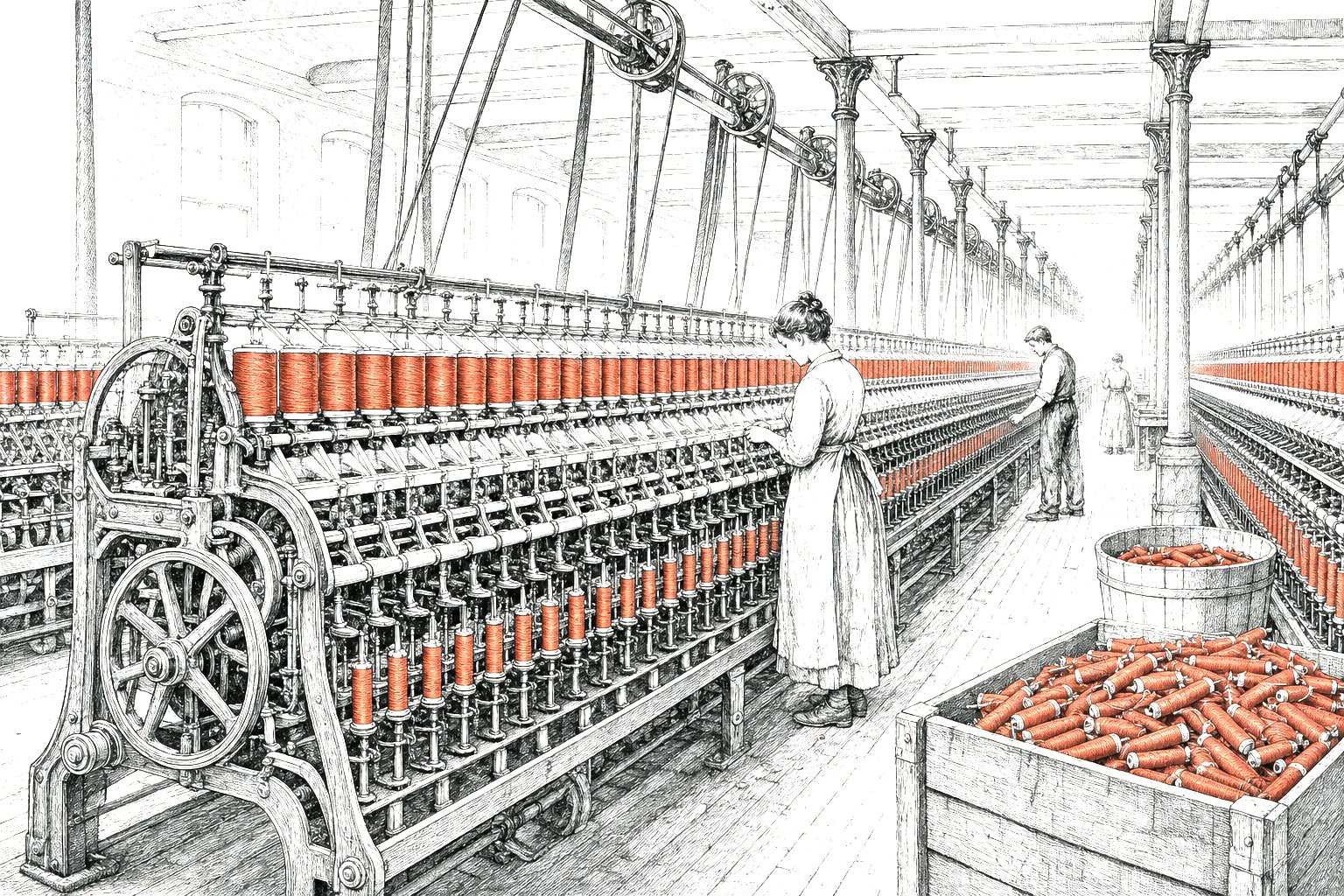
The machine that made these buildings the shape they are was the spinning mule, invented by Samuel Crompton in 1779. It drew out and twisted the yarn on a carriage that ran out and back along the floor. Richard Roberts of Manchester patented his self-acting mule in 1825 and an improved version in 1830; a mule carriage could hold up to 1,320 spindles. Mules were worked in pairs by a minder with two boys, the little piecer and the big or side piecer, who joined broken threads while the carriage moved. At its peak Lancashire held five million mule spindles. The rival ring frame was little used in Lancashire until the 1890s.
Weaving was a separate trade, increasingly done on power looms such as the one Roberts patented in 1822.
A steam mill drove its machines from a central engine through line shafts, gears or ropes, and the engine needed boilers; in Lancashire mills that usually meant the two-flue Lancashire boiler. The physics of turning that heat into motion is on the from water to steam page.
Working conditions and the law
Children were part of the workforce from the start. The 1819 Cotton Mills and Factories Act banned children under nine from cotton mills and limited those aged nine to sixteen to twelve hours a day, though it was weakly enforced. The 1833 Act created a professional Factory Inspectorate with the right to enter mills. The 1844 Act required dangerous machinery to be fenced, and the Ten Hours Act of 1847 limited women and young people in textile mills to 63 hours a week from July 1847 and 58 from May 1848.
Beyond spinning: Paterson Zochonis and Vimto
Not every Manchester business of the cotton age ran spindles. Paterson Zochonis began in West Africa. George Paterson, a Scot, and George Zochonis, a Greek, met in the 1870s while working for the trading house of Fisher and Randall in Freetown, Sierra Leone, and in 1879 they set up a trading post of their own. The business was incorporated in Britain as Paterson Zochonis and Company in 1884, with an office in Liverpool, and in 1886 it opened a head office in Manchester, at the centre of the Lancashire cotton trade.
The firm made none of what it sold at first. From West Africa it shipped palm produce, groundnuts, coffee, hides, skins and timber; in the other direction went textiles, above all wax-printed cotton, made from unbleached grey cloth that Manchester firms printed to its designs. Manufacturing came later. A soap factory at Aba in Nigeria was bought in 1948, the Cussons Group, maker of Imperial Leather soap, was acquired in 1975, and the company took the name PZ Cussons in 2002.
Vimto is a smaller story with a longer life on the shop shelf. John Noel Nichols, a Manchester wholesaler of herbs, spices and medicines, created the drink in 1908 and sold it as Vim Tonic, a health tonic. He shortened the name to Vimto in 1912, and in 1913 it was re-registered as a cordial instead of a medicine. The original premises were on Granby Row, where A Monument to Vimto by Kerry Morrison was installed in 1992 and restored and repainted in 2011. The company, Nichols plc, moved its head office out to Newton-le-Willows in 1999.
What survives and where to see it
| Building or site | Place | Date | What to look for |
|---|---|---|---|
| Murrays' Old Mill | Ancoats | 1797-1798 | Oldest surviving urban steam-powered spinning mill |
| Murrays' Decker and New Mills | Ancoats | 1802-c.1804 | Restored canal basin |
| Sedgwick Mill | Redhill Street, Ancoats | 1818-1820 | McConnel and Kennedy fine spinning |
| Royal Mill and Paragon Mill | Redhill and Jersey Streets | 1912 | Later rebuild, renamed after 1942 royal visit |
| Brownsfield Mill | Great Ancoats Street | c. 1825 | Birthplace of A.V. Roe and Company |
| Ellenroad Engine House | Newhey, near Rochdale | Engine rebuilt 1916 | 3,000 hp twin tandem engine, steamed monthly |
| Queen Street Mill | Harle Syke, Burnley | 1894-1895 | Steam-driven weaving shed, engine Peace |
The Ancoats buildings, the last big group of Manchester cotton mills still standing in the city, are best seen from the Rochdale Canal towpath, which runs past the Murray and McConnel complexes. Brownsfield Mill, where Avro began in 1910, also backs onto the same canal.
Seeing machinery under power means leaving the city. The Ellenroad Engine House at Newhey keeps the 3,000 hp engine of the closed Ellenroad Ring Mill, two halves named Victoria and Alexandra driving a 28-foot rope drum, and steams it about once a month. Queen Street Mill near Burnley, built in 1894-1895, has the 500 hp tandem compound engine Peace, built by William Roberts of Nelson, and is described as the world's only surviving operational steam-driven weaving shed. It once held 990 looms; 308 remain.