On this sheet / 7 parts
Liverpool Road station is easy to walk past. From the pavement it looks like a row of Georgian town houses with a sundial over one door, not the place where the world's first inter-city railway ended. Yet this is the Manchester terminus of the Liverpool and Manchester Railway, opened on 15 September 1830, and it is the oldest surviving terminal railway station anywhere.
How the line reached Manchester
The Liverpool and Manchester Railway Act received royal assent on 5 May 1826, after an earlier bill had been thrown out. George Stephenson was appointed principal engineer in June 1824, briefly lost the job to the Rennies when the first bill failed, and was then brought back to build the line. It ran for about 31 miles and needed three feats that engineers still cite: the floating crossing of Chat Moss, a bog about 4¾ miles wide where the track was laid on timber and tar barrels; the nine-arch Sankey Viaduct, about 712 feet long; and the Olive Mount cutting, about two miles of rock up to 70 feet deep.
The choice of engine came from the Rainhill Trials of October 1829. Rocket, built by the Stephensons, was the only entrant to finish the course. The line was double track throughout and ran to a timetable, which is why it is so often called the first inter-city railway in the world.
At the Manchester end the railway stopped short of the town centre. The company bought land in Castlefield, on the Salford side of Deansgate, and crossed the River Irwell on a two-arched stone bridge. The last stretch ran on a slightly curved brick viaduct that ended at the slope up from Water Street to Deansgate.
Liverpool Road station history: opening day
The opening on 15 September 1830 was a state occasion. The Prime Minister, the Duke of Wellington, rode in a special train hauled by the locomotive Northumbrian, and crowds lined the route. At Parkside, roughly halfway, the trains stopped to take on water.
William Huskisson, MP for Liverpool and a former cabinet minister, got down onto the track to speak to Wellington. Rocket came along the other line, Huskisson fell between the rails, and the engine crushed his leg. He was taken to Eccles and died in the vicarage there. It was the first widely reported railway passenger death, and when the procession finally reached Manchester the mood was sour.
None of that slowed the business. Within weeks the station was handling nearly 800 passengers a day. Only first and second class were carried, and each had its own booking hall and waiting room, so the building has two separate public entrances on Liverpool Road. The sundial sits over the first-class one.
What survives on the site
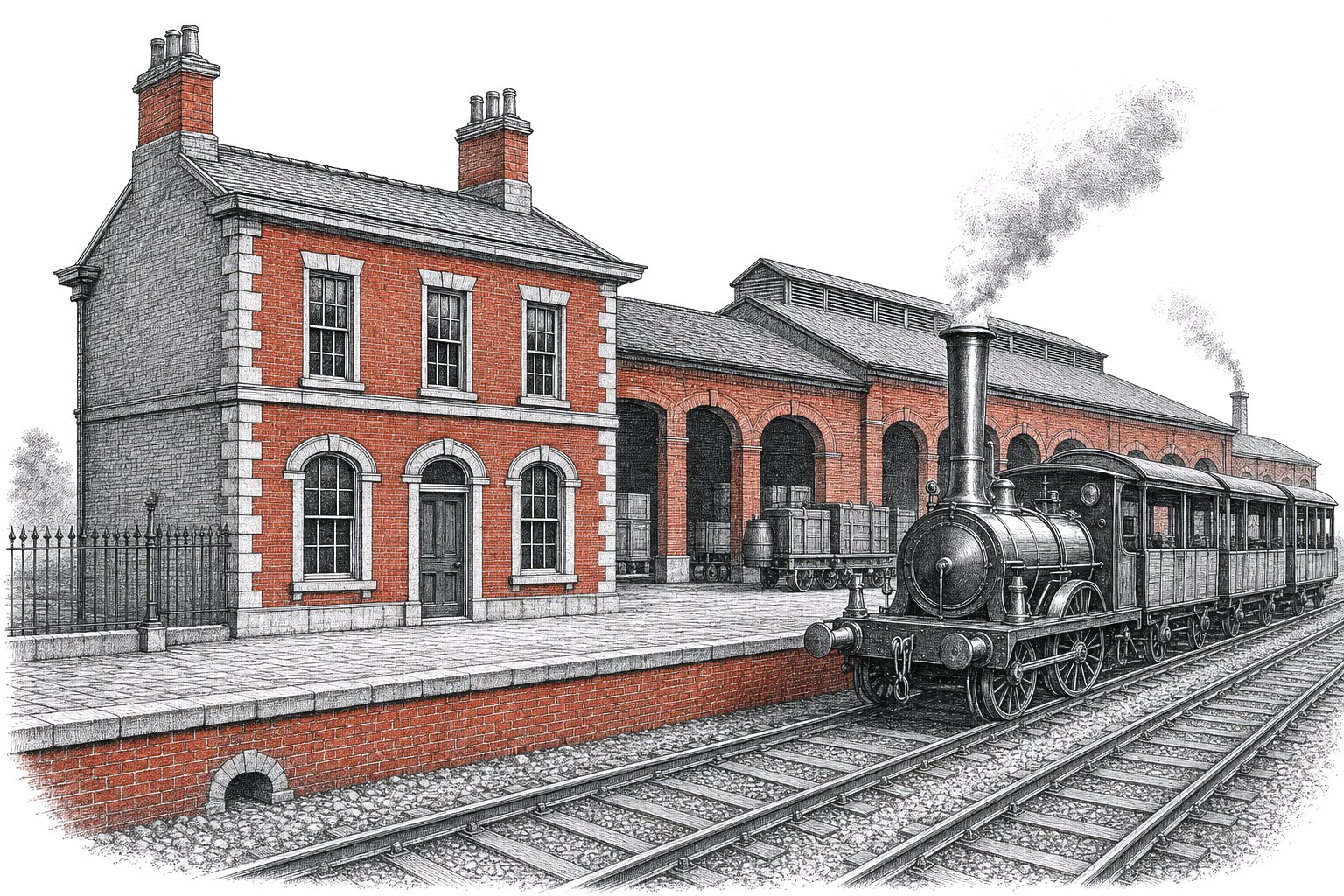
Three things are worth looking for. The first is the station agent's house on the corner of Liverpool Road and Water Street. It was an existing house that the railway bought for its agent, which is why it looks older and plainer than the rest. The second is the passenger building next to it: brick, with stucco rendering scored to imitate stonework, a common Georgian trick for looking expensive on a budget. The third is behind and above you. Trains ran at first-floor level on the viaduct, so passengers bought their tickets at street level and climbed stairs to the platform. That makes it a candidate for one of the first elevated stations in the world, and the arrangement is still clear from the street.
Across the tracks stands the 1830 warehouse, opened at the same time as the station. It is red brick in Flemish bond with sandstone dressings and a slate roof, three storeys high, but only two face the railway. The difference in level was deliberate: wagons on the viaduct loaded and unloaded straight into the upper floors, while carts came in at street level below. Handling was done by hand at first, and steam hoists were installed within a year because the men could not keep up. A hydraulic system replaced the steam one between 1866 and 1880.
The warehouse is usually credited to George and Robert Stephenson, as in the official listing, though other accounts say it was almost certainly designed by the Liverpool architect Thomas Haigh. If you read a confident attribution on a panel or in a guidebook, treat it as one opinion.
Liverpool Road station facts
The key facts are gathered in the table below, with dates taken from the listing descriptions.
| Item | Detail |
|---|---|
| Railway | Liverpool and Manchester Railway |
| Opened | 15 September 1830 |
| Engineer of the line | George Stephenson |
| Length of line | about 31 miles (50 km) |
| Passenger traffic | first and second class only |
| Early use | nearly 800 passengers a day within weeks |
| Closed to passengers | 4 May 1844 (services moved to Manchester Victoria) |
| Goods use ended | 1975 |
| Sold | 1978, to Greater Manchester Council for £1 |
| Station listing | Grade I, 18 December 1963 (NHLE 1291477) |
| 1830 warehouse listing | Grade I, 7 May 1973 (NHLE 1282991) |
| Main line link removed | 2015, for the Ordsall Chord |
Why passengers left after 14 years
Liverpool Road was a good place to start a railway and a bad place to grow one. It sat on the south-western edge of Manchester, and the lines that followed came in from the north and east. Through services to Birmingham began after the Grand Junction Railway opened on 4 July 1837, and through carriages ran to London Euston from 17 September 1838, but every one of them still had to end in Castlefield. That short passenger life is the part of the station history most often misunderstood.
The answer was to extend the line to Hunt's Bank and a new station at Manchester Victoria. Passenger trains moved there on 4 May 1844 and Liverpool Road station Manchester became a goods depot. The Liverpool and Manchester Railway itself lost its independence soon after: the Grand Junction absorbed it on 8 August 1845.
A goods yard for 130 years
As a goods station the site kept growing. A carriage shed was built along Liverpool Road in 1831, followed by two warehouses for cotton the same year and a steam engine to move goods. Hydraulic power came in the 1860s and a steam gantry crane in the 1880s, converted to electricity in the 1920s. The Byrom Street and Grape Street warehouses were reached by an iron viaduct. Ownership passed from the London and North Western Railway to the London Midland and Scottish in 1923 and to British Railways in 1948.
British Railways stopped using the station and its warehouses in 1975. Granada Television bought the Grape Street warehouse and buildings around it shortly afterwards, and in 1978 Greater Manchester Council bought the station for a nominal £1. That price is often repeated as a joke, but it reflected the cost of repairs, not the value of the history.
Visiting and what to look for
A few facts make a visit easier to read on the ground. The buildings of Liverpool Road station Manchester stand in Castlefield, a short walk from Deansgate station and the Castlefield canal basin, and the museum site they belong to is open, although the 1830 station building is closed for restoration and the warehouse opens mainly for events. If you only have ten minutes, stand opposite the station front and count the doors: the two entrances for the two classes are the clearest sign that this was built for passengers, not freight. Then walk to the Water Street end to see how the viaduct meets the building.
The track link to the national network survived for about 185 years. It was cut when the Ordsall Chord was built, approved in March 2015, and the main line connection was removed later that year. Liverpool Road station now sits beside the railway it started, with no way for a train to reach it.
For the canal that brought coal to the same corner of Manchester seventy years earlier, see the Bridgewater Canal. The wider context of mills, warehouses and districts is on the industrial Manchester hub, and the locomotives built later in the city are covered on the page about Beyer, Peacock of Gorton. For how a steam engine of the period raised its pressure, read the Lancashire boiler.