On this sheet / 6 parts
The story of Avro Manchester begins in a cotton mill. On 1 January 1910 Alliott Verdon Roe and his brother Humphrey registered A.V. Roe and Company at Brownsfield Mill, Great Ancoats Street, the first firm in Britain set up to build aeroplanes. Humphrey supplied the money from the family webbing business, and Alliott supplied the designs. Their early Roe I Triplane carried the name Bullseye, after a brand of braces Humphrey's business made.
Brownsfield Mill and the Roe brothers
Brownsfield Mill was built around 1825 at Binns Place, beside the Rochdale Canal, one of the many cotton and engineering buildings that made Ancoats the world's first industrial suburb. It still stands, listed Grade II*, and has been converted into flats under the name Avro. For the mills around it, see the Manchester cotton mills page.
An aircraft maker in a cotton mill sounds odd, but a mill offered what a small workshop needed: open floors at a modest rent and a canal at the back door.
In 1911 the company took on Roy Chadwick as Alliott's assistant and draughtsman. He became chief designer in 1918, and the Lancaster was his team's work. Humphrey ran the business as managing director until he joined the Royal Flying Corps in 1917.
The Avro 504 and the move out
The aircraft that made the firm was the Avro 504, first flown in September 1913. It was used mainly as a trainer, a job it was still doing in 1933. Production reached 8,340, built at Hamble, Failsworth, Miles Platting and Newton Heath. A mill floor in Ancoats could not cope with numbers like that, and the company moved to larger premises on Clifton Street.
An airfield was the other problem. In 1924 Avro moved its flight testing to New Hall Farm at Woodford, in Cheshire, which remained the company's aerodrome for the rest of its life. Alexandra Park, Chadderton and Trafford Park appear among its other sites.
Chadwick, Chadderton and the Lancaster
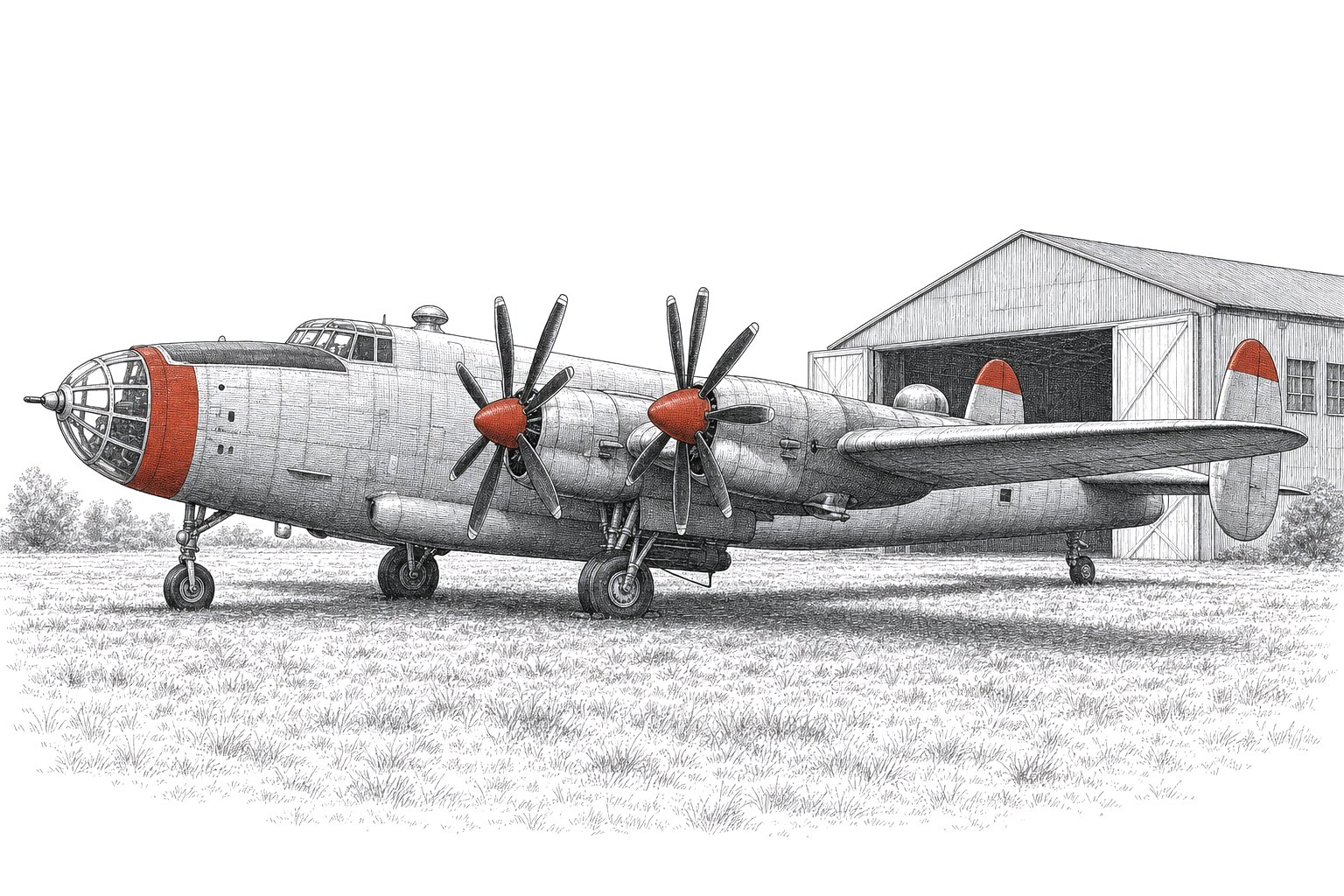
The Avro Manchester was a bomber from Chadwick's team, and the Lancaster was developed from it as an improved Manchester, with four Rolls-Royce Merlin engines. The prototype Lancaster first flew on 9 January 1941 from RAF Ringway, now Manchester Airport. Most wartime Lancasters were built at the Chadderton factory near Oldham and taken to Woodford for assembly and test flying.
Other firms built them as well. Metropolitan-Vickers at Trafford Park made 1,080 Lancasters, as well as 43 Manchesters; its first 13 Manchesters were destroyed in final assembly when the Mosley Road factory was bombed on the night of 23 December 1940. A shadow factory at Yeadon, next to what is now Leeds Bradford Airport, built about 700. The final total was 7,377. Lancasters of No. 617 Squadron flew the raid on the Ruhr dams in 1943, Operation Chastise, in modified Mk III aircraft.
Woodford: the Avro Shackleton and the Vulcan
After the war the Lancaster's family went on. The Avro Shackleton, a maritime patrol aircraft derived from the Lancaster, made its first flight from Woodford on 9 March 1949 with chief test pilot Jimmy Orrell at the controls of prototype VW135. Its four Rolls-Royce Griffon engines drove contra-rotating propellers, and crews called it the Growler for the noise. It entered service with No. 120 Squadron in April 1951 and stayed in RAF service until 1991, 185 having been built; a later version, the AEW.2, also flew as an airborne early warning aircraft.
The Vulcan was a different kind of aircraft altogether, a delta-winged jet bomber. Roly Falk flew the prototype, VX770, solo on 30 August 1952. The RAF took its first Vulcan B.1, XA897, in September 1956, and 136 were built including prototypes. Its only combat missions were the Black Buck raids of the Falklands War in 1982, and it left RAF service in March 1984. One aircraft, XH558, kept flying until October 2015.
The Avro 748 twin turboprop followed in 1960. Three years later, in July 1963, the company was absorbed into Hawker Siddeley Aviation and the Avro name was dropped.
The name did not stay buried. Between 1994 and 2001 British Aerospace sold its BAe 146-based regional jets as the Avro RJ70, RJ85 and RJ100, borrowing the old brand for an airliner that the Roe brothers' firm never designed. It is a small trap for anyone dating a photograph: an aircraft with Avro on the tail can be from 1913 or from the late 1990s.
An Avro timeline
| Year | Event |
|---|---|
| 1910 | A.V. Roe and Company founded at Brownsfield Mill, Ancoats (1 January) |
| 1911 | Roy Chadwick joins as assistant and draughtsman |
| 1913 | Avro 504 first flies (September) |
| 1918 | Chadwick becomes chief designer |
| 1924 | Flight testing moves to New Hall Farm, Woodford |
| 1940 | First 13 Metrovick-built Manchesters lost in the Trafford Park raid (23 December) |
| 1941 | Lancaster prototype first flies from Ringway (9 January) |
| 1943 | Operation Chastise, the dams raid |
| 1949 | Avro Shackleton first flight at Woodford (9 March) |
| 1952 | Vulcan prototype first flight (30 August) |
| 1956 | First Vulcan B.1 delivered to the RAF |
| 1963 | Avro absorbed into Hawker Siddeley Aviation (July) |
| 1991 | Last Shackletons retired |
| 2011 | BAE Systems leaves Woodford (March) |
Finding Avro's Manchester today
The places are easier to find than the aircraft. Brownsfield Mill is on Great Ancoats Street, with the canal behind it, and the name Avro is on the building. Historic England first listed it on 11 November 1988, and the conversion by Urban Splash produced 31 canal-side apartments. The Rochdale Canal towpath gives the best view of the canal side of the building. Chadderton and Woodford are further out; BAE Systems used the Woodford aerodrome until March 2011.
A common confusion is between the company and its bomber. The Avro Manchester aircraft carries the city's name, but it was one type among many, and a short-lived one once the Lancaster arrived. The earlier part of the city's aviation story, the 1919 transatlantic flight of Alcock and Brown, is told in the City section. For the other engine and machine builders of the area, see Machines.