On this sheet / 7 parts
Metropolitan-Vickers was the name on the gate for most of the twentieth century, but the works at Trafford Park began as an American idea. In 1899 the Westinghouse company founded a British subsidiary, bought 130 acres on two sites in the new industrial estate beside the Manchester Ship Canal, and in 1902 began making turbines and electric generators there. By 1903 British Westinghouse employed about half of the park's 12,000 workers.
The estate itself was barely older. Ernest Terah Hooley had bought the Trafford family's park on 23 June 1896 for 360,000 pounds and formed Trafford Park Estates; Marshall Stevens, who had been general manager of the Ship Canal Company, ran it as managing director from 1897 to 1930.
From Westinghouse to Metrovick
During the First World War a holding company was set up to separate the factories from American control, and by 1918 the business was fully British. On 15 March 1919 Vickers agreed to buy the Metropolitan Carriage, Wagon and Finance Company for almost 13 million pounds, and with it the Trafford Park works. On 8 September 1919 British Westinghouse became the Metropolitan Vickers Electrical Company. Everyone called it Metrovick, or Metrovicks.
An Institution of Electrical Engineers report of 1923 described about 9,000 workpeople and roughly 1.5 million square feet of shop floor on the 130-acre site.
Turbines, generators and radio
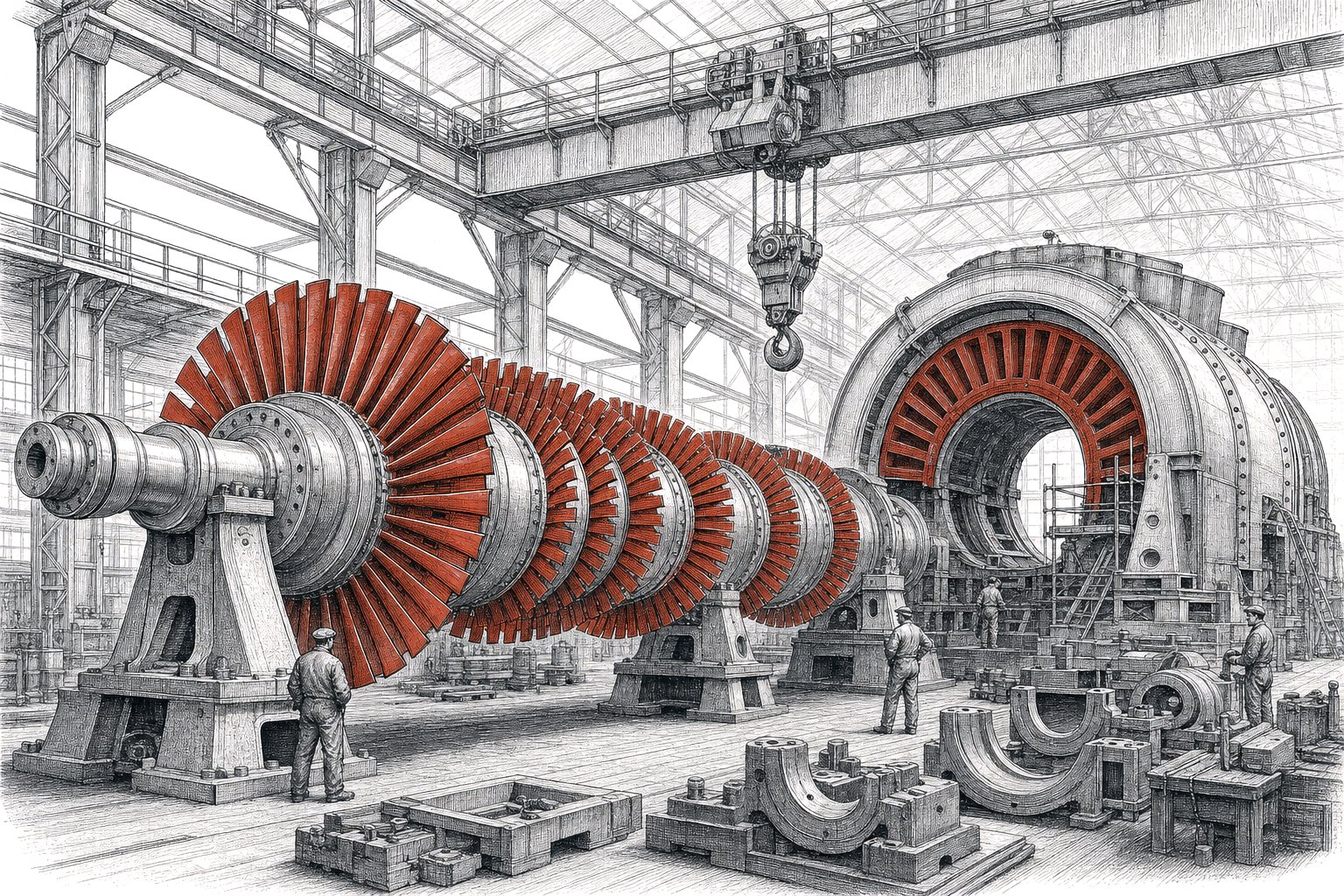
Power plant was the core of the business. In 1935 Metropolitan-Vickers built a 105 MW turbogenerator for Battersea Power Station, the largest in Europe at the time. For the stations closer to home that needed plant of this kind, see the power stations of Greater Manchester.
Turbines also brought the company its strangest episode. In 1933 six Metrovick engineers working in the Soviet Union were arrested after faulty turbines, tried in Moscow and found guilty of espionage and wrecking. The British government intervened, and they were released.
Radio was a sideline that turned into something bigger. After the First World War the company set up a laboratory to design receivers, and in 1922 station 2ZY began broadcasting evening programmes of announcements, stories and music from the Trafford Park works. The same year Metrovick was one of the six companies that founded the British Broadcasting Company. It started building radar in 1937.
Metrovick at war
The Second World War turned an electrical works into an aircraft factory. Metrovick built Avro bombers under licence from Avro: 43 Manchesters, 1,080 Lancasters by the end of the war, and 79 of the Lincoln derivative. The cost was high. On the night of 23 December 1940 the aircraft factory on Mosley Road was badly damaged in an air raid, and the first 13 Manchesters it had built were lost in final assembly.
The engineers also worked on jets. The Metrovick F.2 was the first British axial-flow jet engine and flew in 1943 in a Gloster Meteor. In 1947 a Metrovick G.1 Gatric gas turbine went into MGB 2009, making it the world's first gas-turbine-powered naval vessel. By then Metrovick alone employed 26,000 people, and about 75,000 worked across the whole of Trafford Park.
The Metrovick 950 computer
The link to the university was close. In November 1953 Richard Grimsdale and Douglas Webb demonstrated a prototype transistor computer at the University of Manchester, in the group that had built the Manchester Baby. Metropolitan-Vickers adopted the improved 1955 version, switched it to junction transistors and began producing it in 1956 as the Metrovick 950. It had a store of 4,096 words of 32 bits. Six or seven were built, and they were used mainly inside the company. It is generally described as the first commercial transistor computer.
Apprentices and the training school
For many Manchester families the firm's most lasting product was its apprentices. A register published in 1957 ran to 700 pages and listed over 13,000 former apprentices and trainees from four Metropolitan-Vickers factories, covering 1902 to 1956. The training school stood on the Moss Road side of the works.
If you are tracing a relative who served time at Trafford Park, that register is the first place to look, and the dates matter: a man who started in 1915 joined British Westinghouse, one who started in 1925 joined Metrovick, and one who started in 1963 was an AEI apprentice in the same buildings.
The EM2 electrics for Woodhead
Metrovick equipment also went over the Pennines. For the 1,500 V DC overhead electrification of the Woodhead line, British Railways ordered seven express passenger locomotives, the EM2 class, later known as Class 77. Their bodies and bogies were built in 1953 and 1954 at the railway's own Gorton Works in Manchester, which is not the same place as the Beyer Peacock foundry, and Metropolitan-Vickers supplied the electrical equipment, fitted at Dukinfield. They were Co-Co locomotives, numbered 27000 to 27006, and worked mainly between Manchester and Sheffield Victoria.
Names came later, in 1959 and 1960, all taken from Greek mythology: Electra, Ariadne, Aurora, Diana, Juno, Minerva and Pandora. In September 1969 the whole class was sold to Nederlandse Spoorwegen, the Dutch national railway, and renumbered in its 1500 series. Several were preserved: 27000 Electra is at the Midland Railway - Butterley in Derbyshire, and 27003 Diana is in Utrecht, looked after by the Werkgroep 1501.
AEI, GEC and what came after
In 1928 Metrovick and British Thomson-Houston were brought together under Associated Electrical Industries, a group that was never able to exert effective control over its two rival subsidiaries. On 1 January 1960 AEI dropped both names. In 1949 Metrovick had formed a joint company with Beyer, Peacock to build non-steam locomotives, and Class 82 electric locomotives built in Manchester carried Metrovick equipment.
GEC made a 120 million pound bid for AEI in November 1967. From then on the works were part of GEC, and documents from the following decades call the site GEC Trafford Park. Its heavy engineering became GEC Power Engineering, and the parent company renamed itself Marconi in 1999.
Trafford Park itself changed beyond recognition. Industry had almost disappeared from the estate by the 1980s; the Trafford Park Development Corporation, formed in 1987, brought in new firms, and by 2025 about 1,400 companies employing 40,000 people were based there.