On this sheet / 6 parts
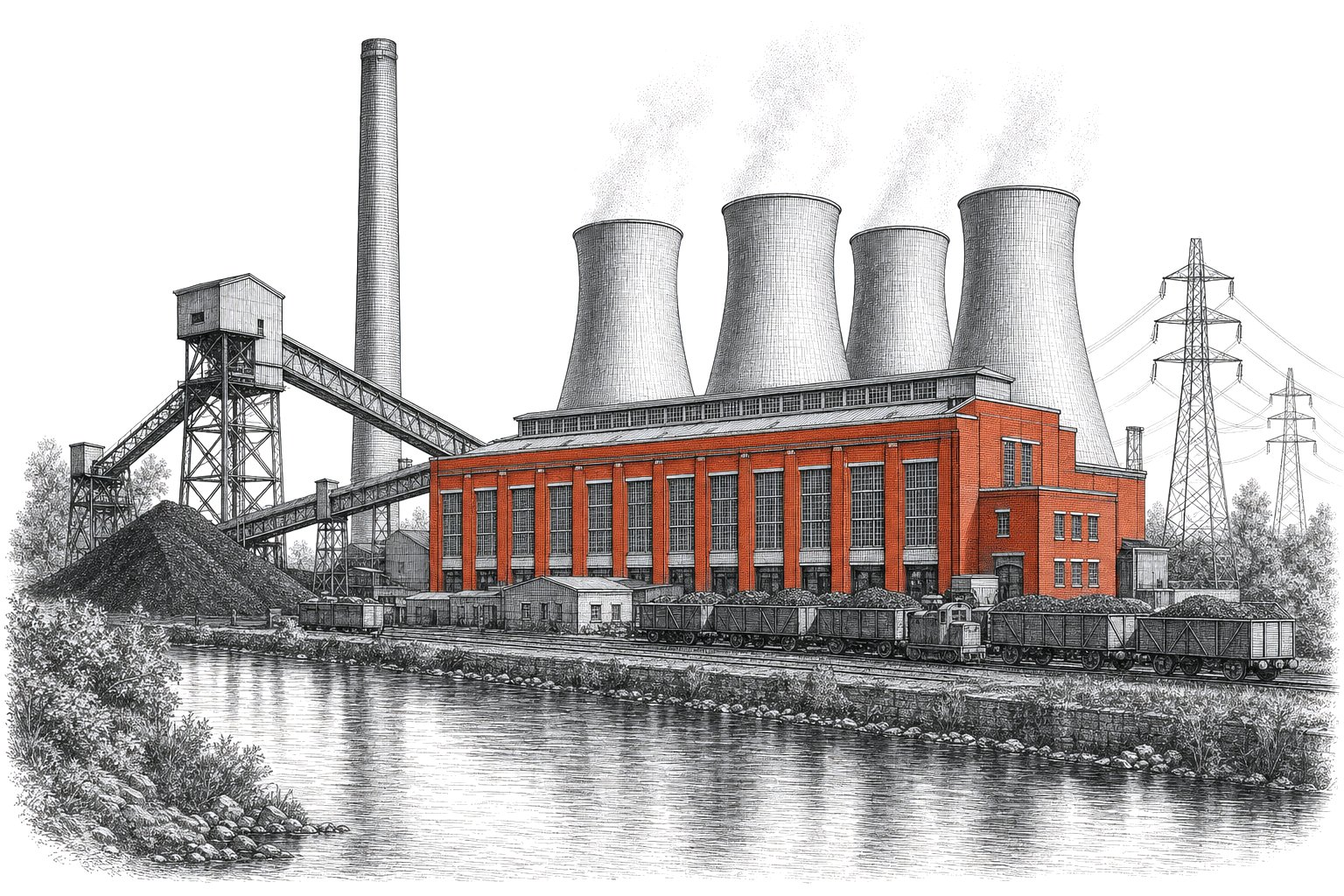
Ask most people to name the power stations in Greater Manchester and they will remember the cooling towers: four at Agecroft by the Irwell, five at Kearsley, the towers of Stuart Street at Bradford. All of them have gone. Only one generating station of any size remains in the county, and it burns gas.
The Manchester power stations history splits into three overlapping eras. Town councils built small central stations from 1893 to light streets and run trams. Between the wars the larger municipal and company plants arrived, sited on canals and rivers for coal and cooling water. After nationalisation in 1948 the Central Electricity Generating Board's big coal stations took over, and between 1974 and 1993 they closed one by one.
A history of municipal electricity
Manchester Corporation opened its first public station on Dickinson Street at the end of July 1893. Dr John Hopkinson designed it to supply direct current to about half a square mile of the town centre. The first plant was four 400 hp Galloway engines and six 100 hp Hornsby compound engines; two 750 kW Ferranti sets followed in 1901 and two Parsons turbines driving 1,800 kW dynamos in 1903. That sequence, reciprocating engines giving way to turbines inside ten years, is the whole early history of the industry compressed into one building.
Bolton had its own supply from Spa Road by 31 October 1894, Stockport by 1899, Rochdale by 1901. Each town ran its own undertaking, and each station stood close to its customers, because direct current could not be sent far economically.
In 1901 the Corporation built Bloom Street next door to Dickinson Street, with four 1,800 kW Musgrave vertical engines driving Westinghouse generators. It supplied most of the traction current for the city's new electric trams, the first section of which opened in June 1901. The building survives and is Grade II listed, so this is the place to go if you want to see what an Edwardian city-centre power station looked like from the street.
Stuart Street, Barton and the canal sites
City-centre plots were too small for what came next. Stuart Street, at Bradford in east Manchester, was built from 1900 and opened in 1902. It had 106.75 MW installed by 1923 and 184.75 MW by 1971. It closed in 1975; the cooling towers came down in February 1978, and the Manchester Velodrome now stands on the site.
Barton, beside the Bridgewater Canal in Trafford Park, began generating in 1923. Coal arrived by barge. It was extended in 1928 to about 122.5 MW installed, closed on 18 March 1974 and was demolished in 1978-1979. A B&Q store occupies the ground.
Kearsley at Stoneclough was a company station, designed in 1927 by Dr H. F. Parshall for the Lancashire Electric Power Company and opened in 1929. A, B and C extensions followed in 1929, 1936-1938 and 1949. Its five cooling towers were demolished in the week of 14 May 1985, four and a half years after the station stopped generating on 27 October 1980.
Agecroft and the post-war coal giants
Agecroft at Pendlebury is the station most people in Salford still mention. The A station opened on 23 September 1925 with 57,500 kW of turbo-generators. The B station followed from 1950, the C station in the 1960s, and B and C were officially opened together in 1962 with a combined 358 MW. The detail that set Agecroft apart was its fuel supply: coal from Agecroft Colliery crossed Agecroft Road on an enclosed conveyor. The colliery shut in March 1991, the station in March 1993, and HM Prison Forest Bank opened on the site in January 2000.
Chadderton B, opened on 8 July 1955, ran four 60 MW Metropolitan-Vickers sets built at Trafford Park. Carrington, where the Mersey meets the Manchester Ship Canal near Partington, had four 60 MW sets and two 350 ft brick chimneys; its first set ran in 1953 and it was officially opened on 20 July 1956. Westwood, at Ince-in-Makerfield near Wigan, opened in 1950.
Power stations in Greater Manchester listed
The list below covers power stations in Greater Manchester, within the present county boundary, where an opening and closing date could be confirmed. Capacities are the figures given for each station in published lists; several plants changed size over their lives, so treat them as a guide.
| Station | Place | Fuel | Opened | Closed | Notes |
|---|---|---|---|---|---|
| Dickinson Street | Manchester city centre | Coal | 1893 | uncertain | First public station in Manchester, DC, designed by John Hopkinson |
| Rhodes Bank | Oldham | Coal | 1894 | 1920 | 0.657 MW, Oldham's first supply |
| Spa Road | Bolton | Coal | 1894 | after 1918 | Town-centre frontage still standing in 2020 |
| Bury | Bury | Coal | 1896 | 1970 | 26 MW |
| Stockport | Stockport | Coal | 1899 | 1976 | 92.5 MW |
| Bloom Street | Manchester city centre | Coal | 1901 | 1951 | Tram supply, Grade II listed building survives |
| Rochdale | Rochdale | Coal | 1901 | 1958 | 10.7 MW |
| Stuart Street | Bradford, Manchester | Coal | 1902 | 1975 | 184.75 MW by 1971, site now the Manchester Velodrome |
| Radcliffe | Radcliffe | Coal | 1905 | 1959 | 3 MW |
| Chamber Hall | Bury | Coal | 1912 | 1969 | 26 MW |
| Back o' th' Bank | Bolton | Coal | 1914 | 1979 | 89 MW at peak, stopped generating 19 March 1979 |
| Greenhill | Oldham | Coal | 1921 | 1960 | 17.2 MW |
| Barton | Trafford Park | Coal, barge-fed | 1923 | 1974 | Manchester Corporation, now a B&Q store |
| Agecroft A | Pendlebury, Salford | Coal | 1925 | 1993 | 57.5 MW, conveyor from Agecroft Colliery |
| Hartshead | Heyrod, Stalybridge | Coal | 1926 | 1979 | 134.75 MW in 1971 |
| Kearsley | Stoneclough | Coal, A station oil from 1965 | 1929 | 1980 | Lancashire Electric Power Company, towers felled 1985 |
| Chadderton A | Slacks Valley, Chadderton | Coal | 1929 | 1967-1972 | Built for Oldham Corporation, 41.25 MW |
| Westwood | Ince-in-Makerfield, Wigan | Coal | 1950 | 1980s | 120 MW |
| Chadderton B | Chadderton | Coal | 1955 | 1982 | Four Metropolitan-Vickers 60 MW sets |
| Carrington | Carrington, near Partington | Coal | 1956 | 1991 | Four 60 MW sets, first set 1953 |
| Agecroft B and C | Pendlebury, Salford | Coal | 1962 | 1993 | 358 MW together, now HMP Forest Bank |
| Carrington CCGT | Carrington | Natural gas | 2016 | operating | 884 MW, commercial operation 18 September 2016 |
Two common misreadings of lists like this one. Bold power station is often filed under Manchester, but it stood near St Helens in Merseyside. And Partington never had a station of its own; the Carrington plants stand right beside the village, which is why both names turn up in older references.
What survives and where to look
Very little of the Manchester power stations history is still standing, but what is left is easy to find. Bloom Street, also known as the Winser Street station, is the most complete surviving building. The frontage of Bolton's Spa Road station was still in place in 2020. At Chadderton the electrical substation outlived the power station and was replaced by a £25 million indoor substation on the same site, beside the Broadway Business Park that covers the rest.
Elsewhere you need the map, because the sites have been reused rather than left empty. Stand outside the Manchester Velodrome and you are on the Stuart Street site. The B&Q in Trafford Park sits where Barton's turbine hall was, beside the canal that brought its coal. HM Prison Forest Bank covers Agecroft, and Kearsley at Stoneclough was demolished completely.
Gas and the end of coal
The National Grid made the small town stations pointless. The big coal plants then lost out to larger, more efficient sets elsewhere on the network, and the last coal-fired power stations in Greater Manchester closed in a run that started at Barton in 1974 and ended at Agecroft in 1993. Chadderton B was declared redundant after structural changes to the grid in 1982.
Carrington came back. ESB Group bought an 85 per cent stake in a gas project there from Carlton Power in 2008, and the £500 million combined cycle station began commercial operation on 18 September 2016, generating 884 MW from the same stretch of the Ship Canal where the coal station had stood. For the wider picture of how the city was supplied before electricity, see the Manchester energy history hub; for the science of turning heat into work, the page on James Joule.