On this sheet / 7 parts
A bed warmer solved a real problem in houses where the only heat came from one fire downstairs. Sheets were cold and often damp, and getting into them was unpleasant enough that people paid for brass and copper to fix it. The object changed four times in four centuries, and each change follows a change in how the house itself was heated: coal fires, then hot water from a kettle, then rubber, then mains electricity.
That makes old bed warmers a small, handy record of domestic energy, and the reason they turn up in a drawing archive about machines and power.
The warming pan and its coals
The first bed warmer was a pan of embers. Warming pans are mentioned in French documents of the 14th century, appear in European paintings by the 16th, and by the 17th century had become ordinary household objects in England.
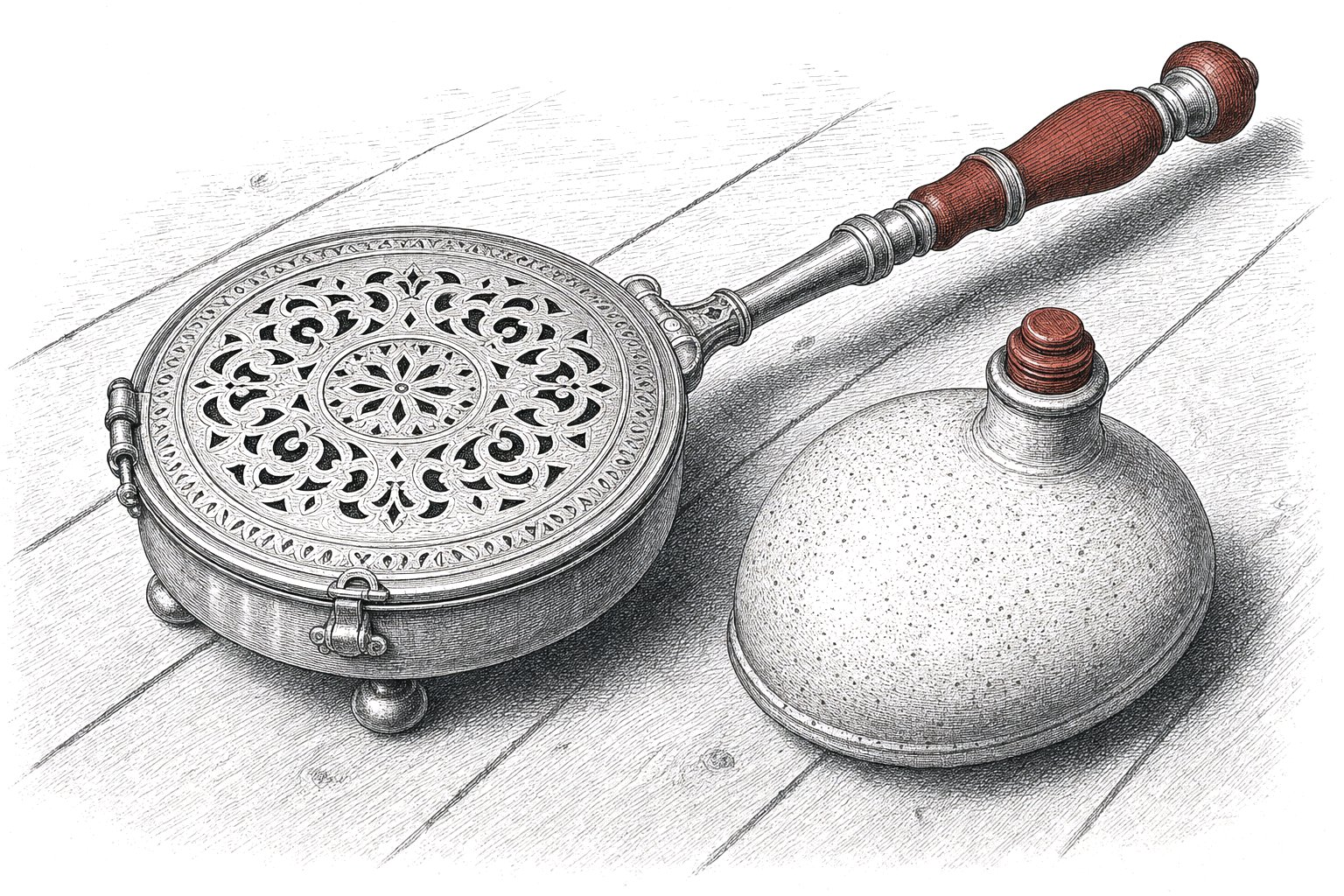
A 17th-century English example in the Victoria and Albert Museum shows the form. It has a brass pan with a perforated, engraved lid and an iron handle with brass mounts, and it stands 123 cm long overall, with a pan 36 cm across and 13.5 cm deep. The engraving shows a cavalier and his lady, which has led to the suggestion that it was a wedding present. The pan was filled with hot coals from the fire and passed between the sheets by its long handle just before the occupants got into bed. Then it came out. Leaving it in would have scorched the linen, and keeping the pan moving was a servant's job.
Pans were polished and often pierced or engraved, so between uses they hung on a hook on the bedroom wall as a piece of decoration. The museum notes that pans were usually wrought iron with brass or copper lids, and that the very wealthy had silver ones. Handles were iron, turned wood or brass. The fuel was whatever burned in the grate, and in a Lancashire house that usually meant coal from pits like those on the Manchester coalfields sheet.
Stoneware pigs and other hot water bottles
The next step replaced embers with hot water. A sealed container could stay in the bed all night, and it carried far less risk of fire. Before rubber, such bottles were made of zinc, copper, brass, glass, earthenware and even wood; the metal ones had to be wrapped in cloth to avoid burns.
The type most often found today is the stoneware bottle, a domed or cylindrical body with a screw stopper. Potteries marked them on the shoulder. One catalogued example reads "Doulton's improved foot warmer" in a scroll, with "Lambeth, London" beneath and an instruction at the knob end to warm the bottle before use. Others carry the stamp "Bourne Denby England", from William Bourne's pottery at Denby, which made salt-glazed stoneware. These bottles are often called pigs in catalogues and family memory, because of the room they take up in a bed.
Rubber and the modern bottle
India rubber hot water bottles were in use in Britain by 1875. The shape still sold today was patented in 1903 by the Croatian inventor Slavoljub Eduard Penkala. Once rubber bottles were cheap, many households threw their stoneware ones out.
Rubber has one weakness that matters for anyone who finds an old one in a drawer. Natural rubber oxidises and degrades, and a bottle can split suddenly after filling and scald the user. In the UK, new bottles are made to British Standard BS 1970, revised in 2012, which covers materials, filling and the safety instructions printed on them. An old rubber bottle is a curiosity; it is not a bed warmer any more.
Early electric bed warmers and blankets
Electrically heated pads and blankets were already being made in Europe before the First World War, though the usual stories about who made the first one are thinly documented. What matters for an old example is how the heat was controlled. Modern blankets have an overheat safety thermostat wired in series with the element, or a heat-sensitive layer that cuts the supply above a set temperature. Blankets made before about 2001 may have no such shutoff, and older blankets are treated by fire services as a fire risk.
The underblanket, laid on the mattress beneath the bottom sheet, is the most common type in the UK. It needed a house wired for mains electricity, which ties its spread to the growth of public supply described in the power stations sheet.
Belling of Enfield and the bulb warmer
The best-known British electric bed warmer came from a heating firm. Charles Reginald Belling, born in Bodmin in 1884, trained in electrical engineering with Crompton and Company of Chelmsford and then worked at Ediswan in Ponders End. In 1912 he started his own business in Lancaster Road, Enfield, with Charles Arnold, making electric heaters. Arnold enlisted in 1914 and sold his interest to Belling. Electric water heaters followed in 1913, cookers in 1919 and immersion heaters in 1920. A purpose-built factory opened on Southbury Road in 1924, and the firm moved to Bridge Works, Enfield, the following year.
The Belling bed warmer, first produced in 1939, needed no special element at all. It is a steel disc made of two shallow domes joined together, about 36 cm across, with a handle on the side and a red panel in the centre. Inside sits an ordinary 40-watt light bulb. The bulb gave the heat, and its glow through the red panel showed the warmer was switched on. Laid flat, it warmed the patch of bed around it, much as a hot water bottle does; stood on edge, it worked as an airer for damp sheets. The handle also served to wind up the flex, and the instructions said to take the warmer out before getting into bed.
The design sold for decades. Examples from the 1960s came in pastel shades, and a boxed one in a London borough collection, complete with its instruction leaflet, is dated 1966. Charles Belling died in 1965, and the company was bought by the Glen Dimplex Group in 1992. One Belling warmer in a school handling collection is pale mauve, which places it in that later pastel period.
How to date and identify an old bed warmer
Warming pans first. A pan with a lid that is both pierced and engraved with figures or flowers, an iron or turned wooden handle and a hanging ring fits the 17th-century pattern seen in museum collections. Without a dated comparison it is safer to say early or later than to name a decade.
For stoneware, read the mark. The maker's name and town often appear on the shoulder, and a stamped country name such as England suggests the piece was made after 1891, when the American McKinley tariff required imported pottery to show its country of origin. Treat that as an earliest likely date, not a firm one. Check that the stopper belongs: one museum example pairs a Doulton stopper with a Denby body. A Bakelite screw stopper points to the 20th century; one bottle fitted with one was bought early in that century.
For electric blankets, the safety mark is the quickest guide. An old round BEAB mark indicates a blanket more than ten years old. The workshop glossary covers the general vocabulary of fittings and marks used across this register.
Safety with antique electric ones
The advice from fire and rescue services is consistent. Replace an electric blanket that is more than ten years old, even if it looks fine. Do not use one with scorch marks, worn fabric, a damaged flex, damaged tie tapes or loose connections, or where the heating wires inside have shifted, touch or cross. Never use one wet or damp, never together with a hot water bottle, and buy new rather than second-hand.
The numbers explain why. In October 2016 Oxfordshire Trading Standards ran free tests on 831 blankets and failed 177 of them, about one in five; one blanket still in use was fifty years old. A 2011 estimate put the number of UK fires caused by faulty electric blankets at about 5,000 a year. An antique electric bed warmer belongs on a shelf, unplugged, with its flex intact so the next owner can see how it was made.