On this sheet / 7 parts
The number on the gravestone is the first thing people notice. In Brooklands Cemetery in Sale, the stone over James Prescott Joule carries the figure 772.55, a value for the mechanical equivalent of heat, the quantity he spent most of his working life pinning down. Few physicists are buried under a measurement, and James Joule earned his over thirty years of patient work in Salford and Manchester.
A Salford brewer's son
Joule was born on 24 December 1818 on New Bailey Street, Salford, the son of Benjamin Joule, a wealthy brewer, and Alice Prescott. He was taught at home until 1834, when he and his elder brother Benjamin were sent to study with John Dalton at the Manchester Literary and Philosophical Society. Dalton was in his late sixties by then. He took the boys through Euclid and a wide range of natural philosophy, and the habit of exact measurement stayed with James for good.
James Joule never held a university chair. The family brewery paid for his apparatus, and his early research had a practical motive: around 1840 he was testing whether the new electric motors could replace the steam engines in the brewery. They could not, at least not economically, but the work led him to ask where the heat in a working circuit came from. In 1841 he showed that the heat produced in a conductor is proportional to its resistance multiplied by the square of the current. Physics students still learn it as Joule's first law.
The 1843-1850 experiments
In 1843 he went further and argued that the heat in a circuit was generated there, not carried in from somewhere else. That struck directly at caloric theory, the idea that heat was a weightless fluid. In August 1843 he gave his first value for the mechanical equivalent of heat to the British Association meeting in Cork. Nobody responded. The silence is one of the better-known anticlimaxes in British science.
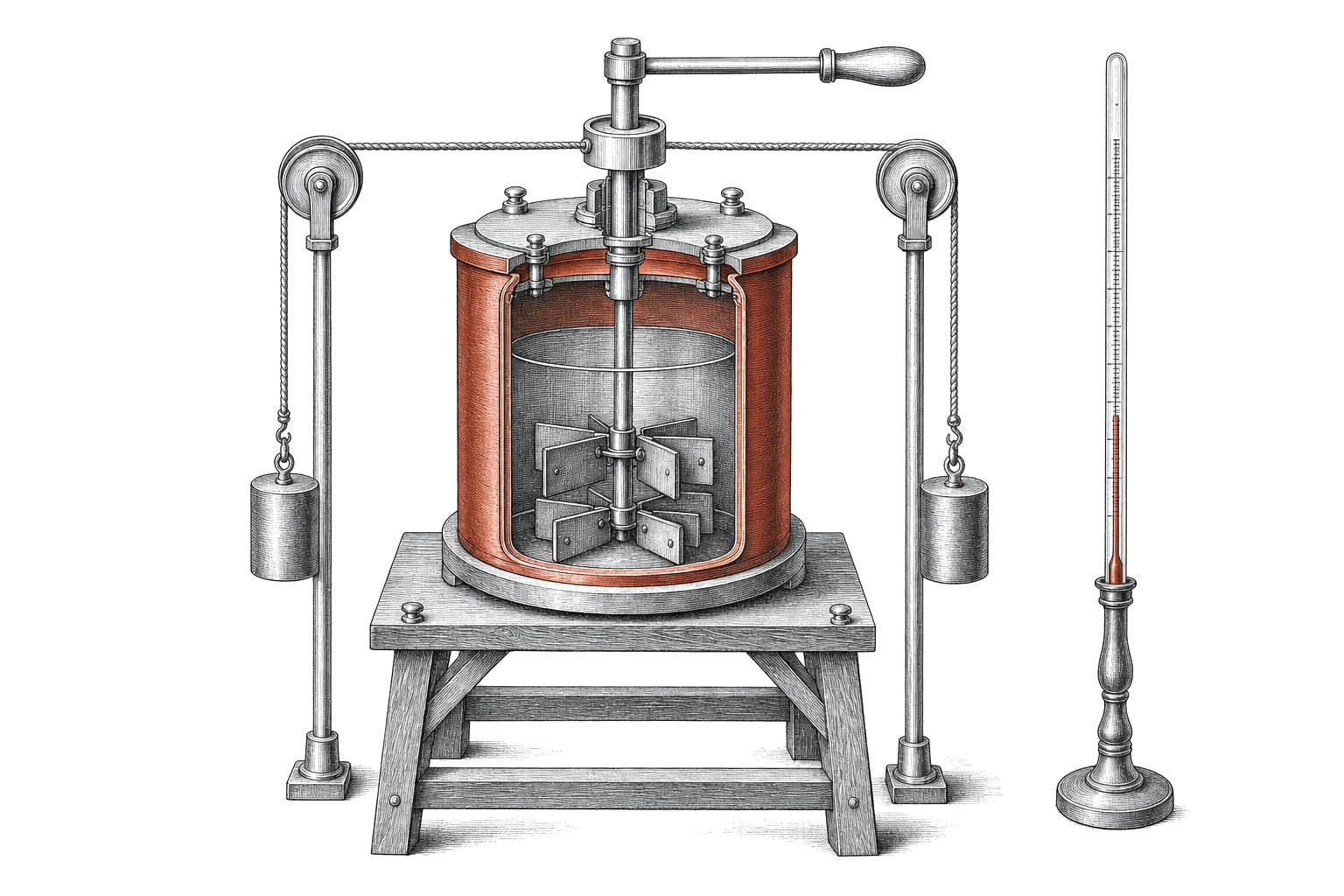
He changed method rather than argument. In June 1845 he reported the first version of the Joule paddle wheel experiment: falling weights turned a paddle wheel inside an insulated vessel of water, and the churning warmed the water by a fraction of a degree. That gave 819 foot-pounds per British thermal unit. He refined the apparatus, the thermometers and the corrections for heat lost to the room, and in 1850 published 772.692 foot-pounds per Btu, about 4.155 joules per calorie. The modern value is about 778 foot-pounds, so he was within one per cent.
Between those dates came the meeting that changed his reputation. At the British Association in Oxford in 1847 his paper was heard by William Thomson, later Lord Kelvin, as well as George Stokes and Michael Faraday. Thomson was sceptical at first, then convinced. The two met again later that year in Chamonix, where Joule happened to be on honeymoon after marrying Amelia Grimes on 18 August.
How the paddle wheel experiment worked
The apparatus is easy to sketch and very hard to build well. Two weights hang from cords wound round a spindle. As they fall, the spindle turns a set of brass paddles in a closed copper vessel full of water. Fixed vanes inside the vessel stop the water simply spinning with the paddles, so all the work goes into stirring and friction. When the weights reach the floor, they are wound up again and the drop repeated many times before the thermometer is read.
The whole difficulty lies in the size of the effect. A single drop barely moves the water temperature, so Joule needed thermometers he could read to a small fraction of a degree, and he had to account for the energy carried off by the weights hitting the floor and the heat leaking through the walls. That patience with corrections is why the Joule paddle wheel experiment is still the textbook case of a careful measurement.
Run Joule's experiment yourself
Work = mass × 9.81 m/s² × height × drops. Temperature rise = work ÷ (water mass × 4,186 J per kg per °C). Real apparatus loses some heat to the vessel and the air, which is why Joule repeated each run many times.
Working out the temperature rise
The calculator on this page does the same sum Joule did, in SI units. The work done by a falling mass is mass times gravity times height, multiplied by the number of drops. The heat needed to warm water is the water mass times its specific heat capacity, about 4,186 joules per kilogram per kelvin, times the temperature change. Set the two equal and solve for the temperature change.
Take a 10 kg mass falling 2 metres, repeated 20 times, with g at 9.81 m/s². Each drop releases 10 x 9.81 x 2 = 196.2 joules, so twenty drops give 3,924 joules. Divide by 1 kg of water times 4,186 J/kg/K and the water warms by about 0.94 K. Halve the water and the rise doubles; double the height and it doubles too. Try a realistic laboratory setup and you will see why Joule was hunting for hundredths of a degree.
The first law and the Joule-Thomson effect
Joule's measurements were the experimental footing for what became the first law of thermodynamics: energy is neither created nor destroyed, only converted, and work and heat are two forms of it. Thomson and Rudolf Clausius built the formal theory; the mechanical equivalent of heat was the number that made it testable.
From 1852 to 1856 Joule and Thomson worked together on gases. They found that a gas forced through a porous plug from high to low pressure usually cools slightly, the Joule-Thomson effect. It later became one of the working principles of industrial gas liquefaction. The Royal Society gave Joule its Royal Medal in 1852 for the 1850 paper.
Henry Roscoe and the Owens College laboratory
Joule did his work at home and in his own laboratories, but the next generation of Manchester science grew up at Owens College. Henry Enfield Roscoe (1833-1915) arrived as professor of chemistry in 1857, after working in Heidelberg with Robert Bunsen, where the two measured how light drives a chemical reaction. In Manchester Roscoe isolated metallic vanadium in 1867 and wrote chemistry textbooks with his colleague Carl Schorlemmer that were used across Britain. He was knighted in 1884, was elected MP for Manchester South in 1885 and then gave up the chair. Roscoe and Joule met through the Literary and Philosophical Society, and in 1895 Roscoe published a book on John Dalton, which keeps the line from Dalton through Joule to the college laboratories easy to follow.
Where to find Joule in Manchester
The unit of energy carries his name, and the city keeps several markers of James Joule. A marble statue by Alfred Gilbert stands in Manchester Town Hall, in the same building as the statue of his tutor Dalton. The Manchester Literary and Philosophical Society lists him among its notable past members. There is a memorial in the north choir aisle of Westminster Abbey, though his body is in Sale, in Brooklands Cemetery, where he was buried after his death at home on 11 October 1889.
His work sits under every other page in this section. The mill engines that replaced the waterwheel, the Lancashire boiler and the turbines in the power stations of Greater Manchester all converted heat into work at the rate he measured. The wider story of how the city was supplied is on the Manchester energy hub.
It is worth knowing one common misconception before you visit the grave. The 772.55 on the stone is not the 1850 result; one account ties it to a later determination of 1878, while the figure in the 1850 paper itself was 772.692.