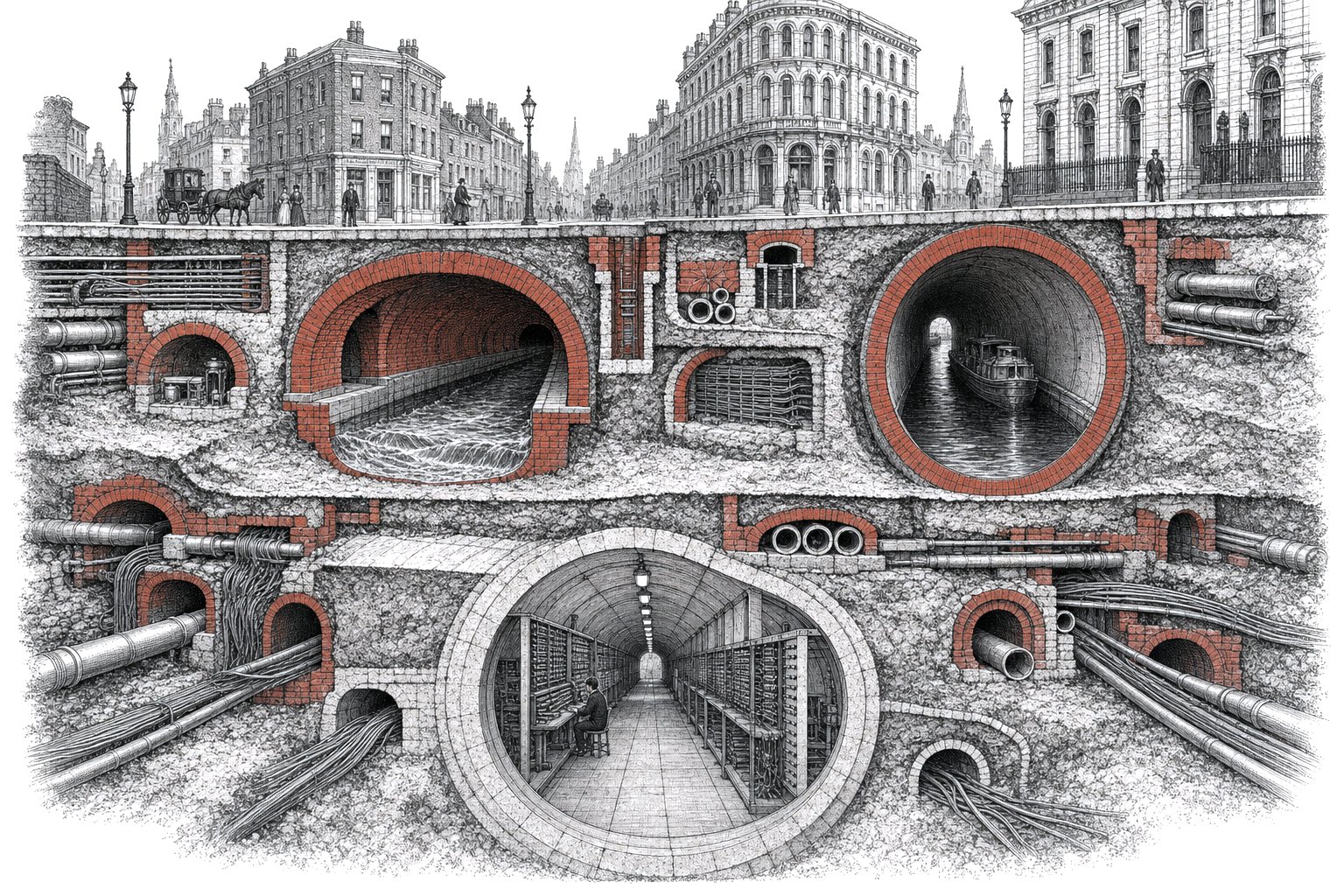
On this sheet / 6 parts
Most stories about Manchester underground tunnels begin in a pub and end with a network of secret passages running from the cathedral to everywhere. The real network is less romantic and more interesting: arches built for riverboats, a canal that ran a quarter of a mile in tunnel to join two waterways, a buried river, a telephone exchange designed to survive a nuclear war and a railway tunnel that only ever existed on paper.
Victoria Arches on the Irwell
Walk along Victoria Street past the cathedral and look over the parapet towards the river. The row of bricked-up openings in the embankment wall below is the Victoria Arches. They were built as the new Irwell embankment went up, completed in 1838 to carry a new road, and the space inside was let to businesses.
By 1895 the Manchester Ship Canal Company had opened at least one landing stage there for steam-packet riverboats. Two steamers, the Shandon and the Eagle, could carry 900 and 1,100 passengers. Staircases led down from Victoria Street. Flooding ended the service in 1906, and the public toilets that stood nearby in front of the cathedral closed in 1967.
In the Second World War the arches were converted into air-raid shelters. The work took three months, cost £10,150 and gave room for 1,619 people. Afterwards they were used for storage, the staircases were removed in the later twentieth century, and by 2009 no steps remained. Today the arches are bricked up and inaccessible. You can see them from three bridges nearby and from the north-west bank of the river, and some still have small ventilation openings.
The Guardian telephone exchange
The most remarkable of the Manchester underground tunnels was built between 1954 and 1957, below 35 metres, under the city centre. The Guardian exchange was one of three deep exchanges, alongside Anchor in Birmingham and Kingsway in London, intended to keep communications going in a nuclear war. It also carried a hardened link between London and Washington by way of a transatlantic cable that landed near Oban and ran through Glasgow, Manchester and Birmingham.
It cost about £4 million, part of it paid by Britain's NATO partners, and its existence was only acknowledged publicly in 1968. The tunnels are about 2 metres across. Two long cable tunnels run from the central complex: east to the cable chamber at Ardwick and west under the River Irwell to Dial House in Salford.
The entrance is a large vertical shaft on George Street, between Princess Street and Dickinson Street, with a goods lift and crane and a swinging blast cover that could seal it. The old pedestrian entrance, a staircase from the former Central telephone exchange on New York Street, has been filled in, and the Piccadilly Plaza complex was built over the site. In March 2004 a fire in one of the tunnels cut 130,000 telephone lines in Manchester and badly disrupted ambulance and fire calls across the North West.
The River Irk under Victoria
Manchester buried one of its rivers to make room for a railway. The River Irk runs in a culvert beneath Victoria station and comes out into the Irwell basin under the railway viaduct, through a cavernous brick tunnel near Ducie Bridge. Writers who have studied it put the culvert at about a kilometre long. A former wooden bridge survives inside and is used as a utility route under the station.
The culvert is a flood channel, not a walkway, and it is not open to the public.
Picc-Vic, the line that was never built
In 1971 the South-East Lancashire and North-East Cheshire Passenger Transport Executive proposed a rail link between Piccadilly and Victoria. The Picc-Vic line would have been 2.75 miles long, just over two miles of it in tunnel, mostly 60 to 70 feet below the centre, with five new stations: Victoria Low Level, Market Street (also called Royal Exchange), Albert Square or St Peter's Square (Central), Princess Street (Whitworth) and Piccadilly Low Level.
In 1973 the transport minister John Peyton turned down the grant, and the scheme was abandoned in 1977 as too expensive. Metrolink, proposed in 1982 and opened in 1992, linked the two stations by tram instead, and the Ordsall Chord added a surface rail link in December 2017. One trace was found underground: in 2012 researchers identified a void about 30 feet below the Arndale Centre, apparently built in the 1970s to allow a future connection to the planned Royal Exchange station.
Canals under Piccadilly and Castlefield
Two canal tunnels run under the centre. The first belongs to the Rochdale Canal, which opened in 1804 from its junction with the Bridgewater Canal at Castlefield. Between Dale Street and Minshull Street the towpath runs largely underground, through a stretch called the Undercroft where an office building was put up over the canal at Piccadilly. Lock 85, listed Grade II and dated 1804-5, sits inside the tunnel. This is the one underground route anyone can walk, though it is dim and the Canal and River Trust has itself described it as feeling unused and uninviting.
The second is the Manchester and Salford Junction Canal, opened in 1839 to link the River Irwell near Quay Street with a branch of the Rochdale Canal near Lower Mosley Street. It was only about a kilometre long, and 499 yards of that ran in tunnel. In 1885 the Great Northern Warehouse was built over its line, with a dock where four large bays and two lift shafts raised goods from boats into storage. Once the Ship Canal Company controlled both the Bridgewater and the Rochdale canals, the junction lost its purpose and was abandoned in 1922. In the Second World War parts were drained and turned into air-raid shelters.
| Site | Date | Depth or size | Can you see it? |
|---|---|---|---|
| Victoria Arches | embankment completed 1838 | river level | from the bridges and far bank only |
| Manchester and Salford Junction Canal | 1839-1922 | 499-yard tunnel | western portal from the Irwell; basin behind the Bridgewater Hall |
| Rochdale Canal, Piccadilly | 1804 | towpath tunnel, Lock 85 inside | yes, public towpath |
| River Irk culvert | under Victoria station | about 1 km | outfall near Ducie Bridge |
| Guardian exchange | 1954-1957 | below 35 m, tunnels about 2 m wide | no public access |
| Picc-Vic tunnel | proposed 1971, dropped 1977 | 60-70 ft planned | never built |
What you can visit, and what you cannot
Most Manchester underground tunnels are closed, and for good reason: culverts flood, cable tunnels carry live services and the arches are sealed. Urban explorers have photographed the landing stages and other spaces, but entering them without permission is trespass and genuinely dangerous.
What you can do legally is walk the Rochdale Canal under Piccadilly, look at the Victoria Arches from the river bridges and find the western mouth of the junction canal from the Irwell side. The eastern end survives as a small basin behind the Bridgewater Hall, and much of the dry tunnel lies beneath the Great Northern Warehouse and the old Granada studios site. For the railway that shares this part of town, see Liverpool Road station, and for how these layers fit the wider story, the industrial Manchester hub. The Elizabethan Warden who lived a few yards from the Victoria Arches, long before anyone dug them, appears on the page about John Dee.