On this sheet / 8 parts
Most Manchester industrial heritage sites are not behind a ticket desk. They are on street corners, under railway arches and beside towpaths, and you can see the important parts of them from the pavement. The twelve places below are chosen because each one still shows how something worked: how coal arrived, how cotton was spun, how a train reached the city, how a library kept soot off its books. All of them were checked against their listing records and current maps.
The coordinates on the map are good to about ten metres. Two clusters, Castlefield and Ancoats, can each be walked in an afternoon. The rest need a tram, a bus or a bike.
Castlefield: canals, warehouses and rails
Start at Castlefield Basin, where the Bridgewater Canal reached Manchester in the 1760s. The basin was the canal's Manchester terminus, and the warehouses that ring it were built to take goods off the boats. Merchants' Warehouse on Castle Street, of about 1827, is a four-storey brick block with two shipping holes that let boats float right inside; it is listed Grade II and has been converted to offices. Middle Warehouse of 1831, built by the Bridgewater Trustees on the Middle Basin arm, stored maize until the 1970s. The full story of the canal is on the Bridgewater Canal sheet.
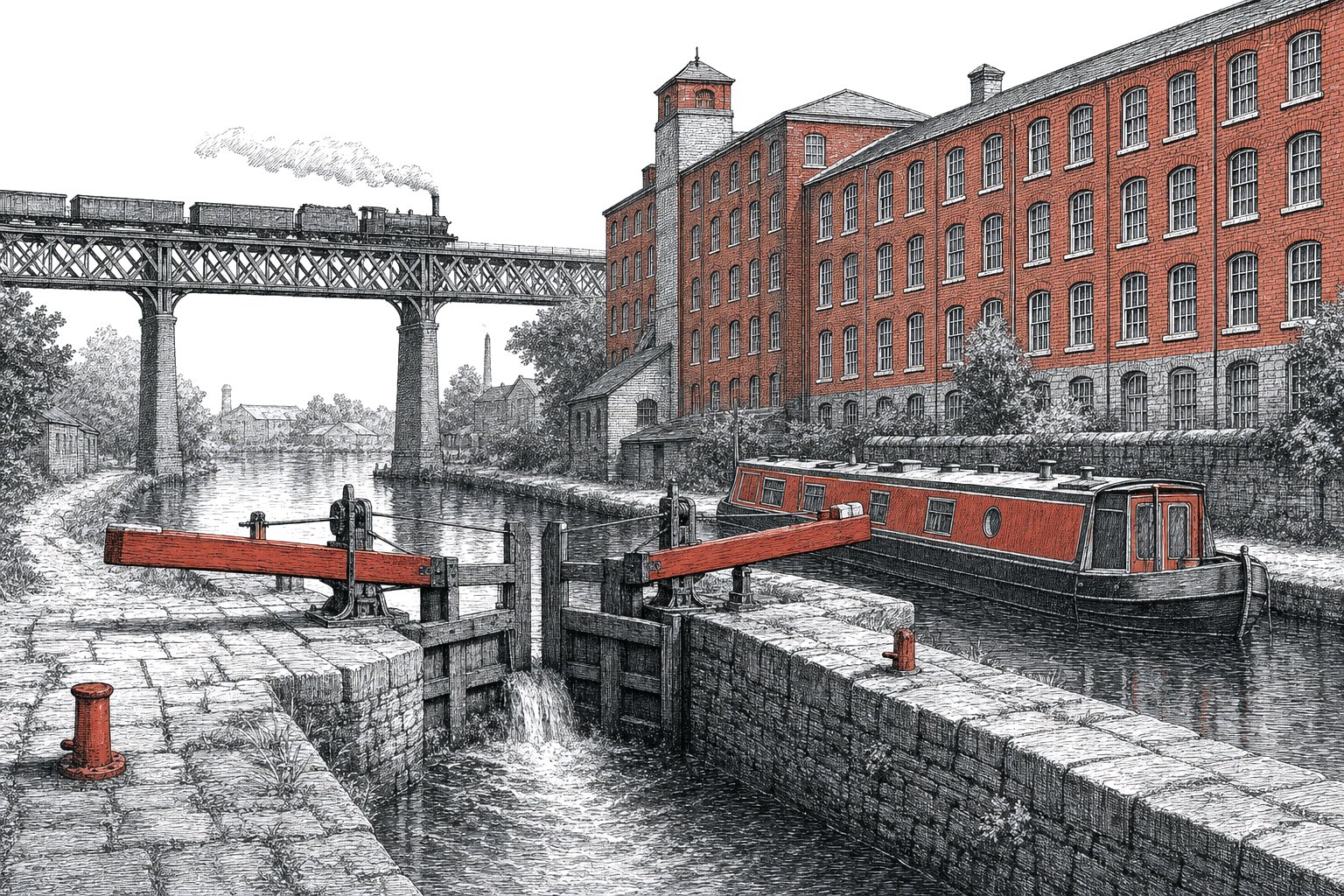
A short walk east is Lock 92 of the Rochdale Canal, known as Duke's Lock, where the Rochdale meets the Bridgewater at Castlefield Junction. It is the last of the canal's 92 locks, counted from Sowerby Bridge 32 miles away, and its name comes from the Duke of Bridgewater's control of the entry into his canal. The lock and Castle Street bridge are listed Grade II. The Rochdale Canal opened in 1804, closed to most traffic under an act of 1952 and reopened along its whole length on 1 July 2002.
Look up and you see the railways that replaced the canals. Four large viaducts cross the basin, the oldest a brick viaduct of 1849 with a cast-iron arch, the newest built in the 1890s. In 1982 the area became the first urban heritage park in the United Kingdom.
Manchester industrial heritage sites on one sheet
- 1 Castlefield Basin and Merchants' WarehouseCastlefield / 1761
Manchester terminus of the Bridgewater Canal, ringed by warehouses such as Merchants' Warehouse of about 1827.
- 2 Duke's Lock, Rochdale Canal Lock 92Castlefield / 1804
Last lock of the Rochdale Canal, where it joins the Bridgewater Canal at Castlefield Junction.
- 3 Liverpool Road stationCastlefield / 1830
Manchester terminus of the Liverpool and Manchester Railway, described as the oldest surviving terminal railway station.
- 4 Murrays' MillsAncoats / 1797
Old Mill here is described as the world's oldest surviving urban steam-powered cotton spinning factory.
- 5 Royal Mill and Sedgwick MillAncoats / 1818
McConnel and Kennedy's spinning mills; Sedgwick Mill dates from 1818-1820, Royal Mill from 1912.
- 6 Chetham's LibraryCity centre / 1653
Founded under Humphrey Chetham's will; Marx and Engels studied in its window alcove in 1845.
- 7 John Rylands LibraryDeansgate / 1900
Lit by its own electricity until 1950, with air drawn through water-sprayed screens against city soot.
- 8 Barton Swing AqueductBarton upon Irwell / 1894
A 1,450-tonne iron trough that swings over the Ship Canal with about 800 tonnes of water inside.
- 9 Worsley DelphWorsley / 1761
Tunnel entrances to about 46 miles of underground mine canals on four levels, now a scheduled monument.
- 10 Victoria BathsChorlton-on-Medlock / 1906
Municipal baths on Hathersage Road, closed in 1993 and winner of the BBC's Restoration in 2003.
- 11 James Joule's grave, Brooklands CemeterySale / 1889
Joule's gravestone in plot B208 carries 772.55, his value for the mechanical equivalent of heat.
- 12 Stockport ViaductStockport / 1840
Twenty-two brick arches built for the Manchester and Birmingham Railway, using roughly 11 million bricks.
Liverpool Road, the first terminus
On the north side of Castlefield stands the Manchester end of the Liverpool and Manchester Railway, which opened on 15 September 1830. The station building is described as the world's oldest surviving terminal railway station. Its tracks run at first-floor level behind the frontage, which makes it one of the first elevated stations too. Passenger trains moved to Hunt's Bank and Victoria on 4 May 1844, but goods traffic carried on until 1975. The station and stationmaster's house are listed Grade I. Opposite, across the tracks, the 1830 warehouse was built in the canal-warehouse tradition, solid brick with a plain face. The Liverpool Road station sheet covers the building in detail.
Ancoats, the mill district
Ancoats is where the steam-powered cotton mill took its urban form, and two of its oldest groups face each other along Redhill Street.
Murrays' Mills were built by the brothers Adam and George Murray from 1797. Old Mill is described as the world's oldest surviving urban steam-powered cotton spinning factory and was first driven by a 12 horsepower Boulton and Watt engine. Decker Mill followed in 1802 and New Mill in 1804. By 1806 the complex held 84,000 mule spindles. The four main mills are listed Grade II*. One detail is easy to miss: New Little Mill of 1908, on Jersey Street, is the earliest mill in Greater Manchester built to run on mains electricity.
Next door, McConnel and Kennedy began their mills in 1797-1798. Sedgwick Mill went up in four blocks between 1818 and 1820. The building now called Royal Mill was put up in 1912 as New Old Mill and renamed in 1942, the year King George VI and Queen Elizabeth visited the site. Its entrance arch still claims a founding date of 1797. Spinning stopped here in 1959. For how these buildings were laid out and powered, see the cotton mills sheet.
Two libraries in the cotton city
Chetham's Library, beside the cathedral, was founded in 1653 under the will of Humphrey Chetham and is called the oldest free public reference library in the English-speaking world. It sits in college buildings that go back to the collegiate foundation licensed in 1421. In summer 1845 Karl Marx and Friedrich Engels read in its window alcove, studying economics books that are still shown there in facsimile.
The John Rylands Library on Deansgate is the opposite case: a building designed against the industrial city. Enriqueta Rylands built it in memory of her husband John Rylands, owner of the largest textile manufacturing concern in the United Kingdom. Basil Champneys designed it, and it opened to readers on 1 January 1900. Electricity was chosen over gas lighting as cleaner and safer, generated on site at 110 volts DC until 1950, and air was drawn in at pavement level through water-sprayed screens to strip out soot and sulphur. Both libraries are listed Grade I.
West to Barton and Worsley
The Barton Swing Aqueduct, opened to commercial traffic on 1 January 1894, carries the Bridgewater Canal over the Manchester Ship Canal in an iron trough 330 feet long. It was designed by Sir Edward Leader Williams and built by Andrew Handyside of Derby. When a tall ship comes, the 1,450-tonne trough swings 90 degrees with about 800 tonnes of water still inside it. The road swing bridge beside it gives the best view.
A few miles on, Worsley Delph is the sandstone basin where the duke's boats entered his mines. Behind its two tunnel entrances lie about 46 miles of underground canal on four levels. The tunnel mouths, sluice gates and the platform between them are a scheduled monument, and the canal water around the Delph is still stained orange by iron oxide from the old workings, despite a clean-up finished in 2004.
South and east of the centre
Victoria Baths on Hathersage Road opened in 1906; the Lord Mayor called it a water palace. Manchester City Council closed it in 1993, and in 2003 it won the first series of the BBC's Restoration. The building is listed Grade II* and was still on the Heritage at Risk Register in 2024, so check its own announcements before planning a visit.
At Brooklands Cemetery in Sale lies James Prescott Joule, who died at home on 11 October 1889. His gravestone in plot B208 carries the figure 772.55, his result for the mechanical equivalent of heat, which the James Joule sheet explains.
The furthest point on this map is Stockport Viaduct, completed in December 1840 for the Manchester and Birmingham Railway. It has 22 main arches of 19.2 metres span, rises to 33.9 metres and used roughly 11 million bricks. It still carries the West Coast Main Line, and the clearest view of it is from the riverside below the town centre.
Manchester industrial heritage sites at a glance
| Site | Area | Date | What to look at |
|---|---|---|---|
| Castlefield Basin | Castlefield | 1760s | Canal terminus, Merchants' Warehouse |
| Duke's Lock (Lock 92) | Castlefield | 1804 | Junction of Rochdale and Bridgewater canals |
| Liverpool Road station | Castlefield | 1830 | First-floor tracks, 1830 warehouse |
| Murrays' Mills | Ancoats | 1797-1806 | Old Mill, Decker Mill, New Mill |
| Royal Mill and Sedgwick Mill | Ancoats | 1818-1912 | McConnel and Kennedy group |
| Chetham's Library | City centre | 1653 | Reading room, Marx and Engels alcove |
| John Rylands Library | Deansgate | 1900 | Electric lighting, air filtration |
| Barton Swing Aqueduct | Barton upon Irwell | 1894 | Swinging iron trough |
| Worsley Delph | Worsley | 1760s | Tunnel mouths, orange water |
| Victoria Baths | Chorlton-on-Medlock | 1906 | Municipal baths |
| Joule's grave | Sale | 1889 | Gravestone with 772.55 |
| Stockport Viaduct | Stockport | 1840 | 22 brick arches |
Planning the walks
The two densest clusters of Manchester industrial heritage sites are less than two kilometres apart. A route from Castlefield Basin past Duke's Lock and up the Rochdale Canal towpath brings you to the Ancoats mills without leaving the water for long. The canal climbs through the city centre on a flight of nine locks, restored in 1974.
For Barton and Worsley, the Bridgewater Canal towpath is the route the coal took, and walking or cycling it from Castlefield out through Stretford makes the point of the canal obvious: it crosses the Irwell valley without a single lock.