On this sheet / 7 parts
An old gas meter is a box of bellows and valves that answers one question: how much gas went through this pipe? Before it existed, the question was simply not asked. The first gas customers paid according to how many lights they had, a system that the engineer Samuel Clegg, like charging by the hour, regarded as unfair. The meter replaced it, and the coin-operated version that followed did something larger, putting gas within reach of households that had no chance of paying a quarterly bill.
Manchester was early to all of this. In November 1817 the town's Police Commissioners built a gasworks on Water Street, and it is described as the world's first municipal installation to sell gas to the public.
Manchester's gas and its meters
The Water Street works supplied gas for street lamps and the police offices. The undertaking passed to Manchester Corporation on 24 June 1843 and was run by the council's Gas Committee, whose minutes from 1824 to 1949 survive in the city archives. New works followed, including Gould Street off Rochdale Road, extended in 1871-1872. On 1 May 1949, under the Gas Act 1948, Manchester's undertaking became part of the North Western Gas Board, which was itself folded into British Gas in 1973.
The wet meter: a drum in water
Clegg had worked out a way of measuring gas volumes by around 1814, but he tried for years to build a dry meter and could not make one register reliably. In 1816 he patented a water meter instead. The year after, he installed a self-acting wet meter of his own design at the Royal Mint, where he and Frederick Accum were fitting gas lighting.
The principle is simple. A drum divided into compartments sits half-submerged in water inside the case. Gas entering one compartment pushes the drum round, the next compartment rises out of the water to release its gas, and every turn of the drum passes a known volume. A train of gears counts the turns. The weaknesses were just as simple: tilt the case and the water level shifts, so the meter under-reads, and in a cold winter the water freezes.
The dry meter: leather bellows
The answer was to measure gas with something that flexed. Patents for a dry, diaphragm meter were filed by William Richards and his partner Croll in 1843 and 1844. Thomas Glover, who set up Thomas Glover and Co in 1844, later claimed to have invented the diaphragm meter; the more careful account is that he improved on Richards's design. The type became known anyway as the Glover two-diaphragm slide-valve meter, and the firm, later Glover and Main, made meters until 1983.
Inside, the dry meter works much like a small steam engine, a comparison worth keeping in mind if you know the valve gear in the water to steam sheet. Two leather diaphragms each sit between a pair of measuring chambers, four chambers in all. D-type slide valves, driven by the movement of the diaphragms, send gas into one side while the other side empties, so the flow to the house never stops. A crank turns the diaphragms' back-and-forth motion into rotation, and that rotation drives the dials. Modern diaphragm meters still use the same arrangement.
The penny-in-the-slot meter
Prepayment or slot meters came into use after 1870, and surviving coin-in-slot meters date from the 1890s. The point was the customer. A family that could find a penny at a time could have gas without a deposit or a quarterly bill, and some gas companies went further and rented out gas cookers paid for through the same slot. Gas cooking reached working-class kitchens that way.
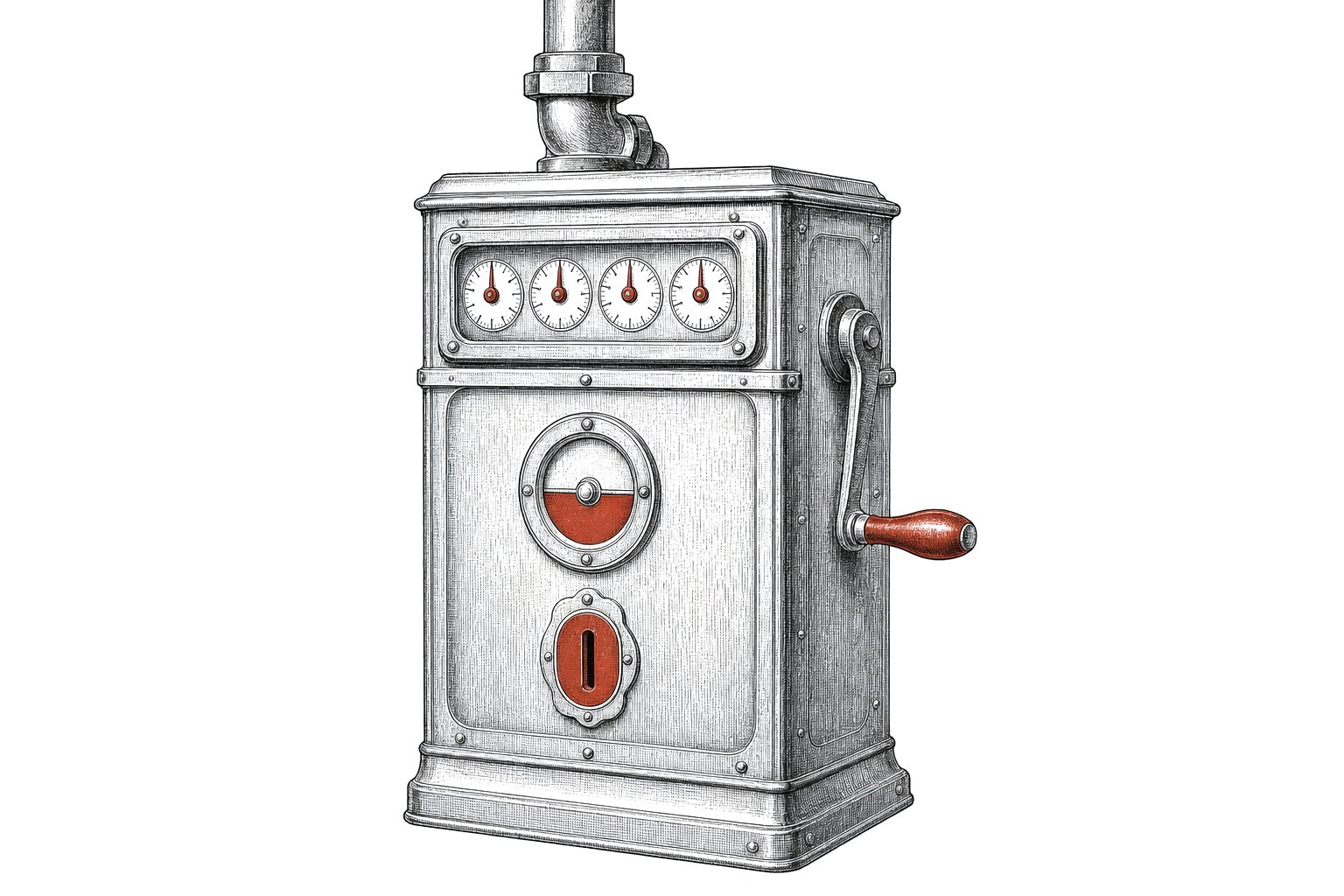
The mechanism sat in the top section of the case, above the measuring chambers. A coin dropped through the slot pressed a lever down onto a toothed wheel. Turning the handle on the outside then turned the wheel, which moved a cam, and the cam opened the valve that let gas through. As gas was used, the meter's own drive, worked by the gas pressure, turned the cam back, and when the paid amount had gone through, the valve shut. Many meters took both pennies and shillings. A penny drove the cam directly; a shilling passed through a second toothed wheel geared twelve to one and turned the cam twelve times as far.
Later meters changed only the coins. Surviving coin-box meters from the 1950s took sixpences and shillings, and 1970s meters were made for 5p and 10p pieces.
How to identify an old gas meter
Start with the dials. Older British meters counted cubic feet on a row of small dials, typically units, hundreds, thousands and ten thousands. A prepayment meter adds a separate circular indicator for the gas still paid for; one late-Victorian example by W. and B. Cowan has a prepayment circle marked from 0 to 280.
Look for a size. Early meters were rated by the number of gas lights they could supply, so a plate reading three lights is an older form of rating; the Cowan meter above is a three-light meter. A 1952 demonstration meter by J. H. Robinson gives its capacity instead, as 100 cubic feet an hour.
Read the maker's name. W. and B. Cowan, Parkinson Cowan, Alder and Mackay, Glover, and J. H. Robinson of Liverpool all appear on surviving British meters. Then look for a verification stamp. Under the Sale of Gas Act 1859, inspectors appointed by local authorities tested meters, and none could be stamped unless it registered within set limits.
A slot, a coin box and a turning handle mean prepayment. The workshop glossary explains the general terms for valves and gearing used here.
The E6: an electronic meter, not a diaphragm
E6 is often taken for another diaphragm meter, because it sits beside the familiar U6 in UK paperwork. It is not one. Government guidance on meter approval under the Gas Act 1986 separates domestic gas meters of diaphragm design, often marked U6 or G4, from those of electronic design, marked E6. The 6 in U6 and E6 is the same capacity rating, 6 cubic metres of gas an hour.
An E6 has no bellows. It measures the gas with pulses of ultrasound and shows the reading on a liquid crystal display with five digits, and its electronics keep checking for malfunction, interference, tampering and service needs. National Grid's meter identification guide of October 2009 recorded 1.6 million E6 meters installed since 1993, and listed versions by Eurometers, Schlumberger and George Wilson; the George Wilson ones were only fitted by National Grid in 1997 and 1998. The serial number begins with E6 and runs to 14 characters, and the case is roughly 150 mm high, 220 mm wide and 75 mm deep.
The weak point is the battery. It was expected to last about ten years, and when it fails the screen goes blank and the meter can no longer record the gas used, although the gas keeps flowing. The same 2009 guide said National Grid Metering planned to replace E6 meters with diaphragm credit meters as a priority. Some prepayment meters were built on the same base: the Landis and Gyr ETX6, also called the Libra 200, is a valved E6 with an electronic token module fixed to the front.
Before you take one home
An old meter that has been off a supply for decades is usually a harmless tin box, but treat it as having once held gas. Never try to connect one, and if a meter is still in place in an old building, leave it to the gas supplier or a registered gas engineer. Meters in British homes are now held to a permitted error of plus or minus 3 per cent under current rules, against 2 per cent for meters approved before the European Measuring Instruments Directive. An old gas meter will not meet either, which is one more reason it now belongs in the archive rather than on a pipe.